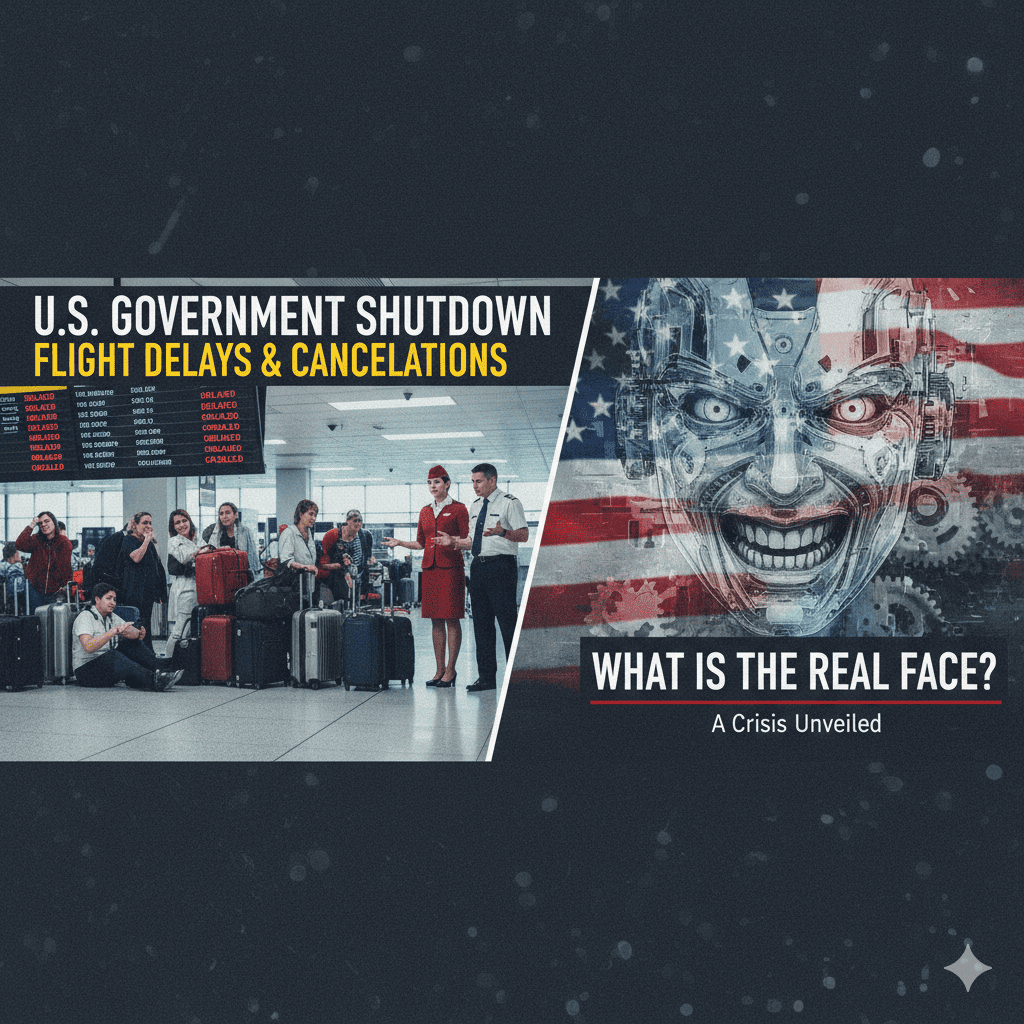
Once again, the government shutdown in America has shaken the entire country’s economy and daily life. This time, its biggest impact has been on the travel industry, especially the air travel sector. Thousands of passengers are facing flight delays and cancellations. But the question arises: why are flights being delayed due to the shutdown? And could this situation become more serious?
Let’s understand the full scenario behind this crisis.
What is US Government Shutdown ?
A U.S. government shutdown occurs when Congress and the President cannot approve the federal budget. This means that many government departments are temporarily closed or their employees are put on unpaid leave.
However, some “essential services”—such as defense, hospitals, and air traffic control—continue to operate, but these employees work without salary. This is the biggest reason for the current flight chaos.
Effect on Air Traffic Controllers
Air Traffic Controllers are the backbone of the air travel system – they monitor the takeoff and landing of every flight. After the shutdown, these people are still working, but without pay.
Imagine, when thousands of employees are working without pay, stress and frustration naturally increase. According to reports, many controllers are taking “sick leave” or missing their shifts – leading to staff shortages at airports.
The direct consequences of this are:
Delays in takeoff and landing
Ground stops (flights temporarily not allowed to take off)
Slow air traffic flow
According to ABC News, the FAA has confirmed that flights at some airports are being intentionally delayed to maintain safety.
How many flights have been delayed?
According to a Reuters report, in the first few days of the shutdown alone:
Around 12,000 flights have been delayed.
Nearly 200 flights have been canceled.
Majorly affected airports:
Chicago O’Hare
Dallas-Fort Worth
Newark
Denver
Nashville
Hollywood Burbank Airport (where the tower itself was unmanned for several hours!)
Many passengers complained that their flights were delayed by anywhere from 30 minutes to three hours. This is just the beginning—if the shutdown continues, the situation could worsen.
What does it mean for travelers?
If you’re planning a U.S. or international flight, keep these things in mind:
1. Your rights in case of a flight delay or cancellation:
If the airline cancels a flight, you receive a full refund—even for non-refundable tickets.
Refunds are available not only for the ticket itself, but also for seat upgrades, baggage fees, and extras.
If the flight is significantly delayed (more than 3 hours domestically or more than 6 hours internationally), and you don’t want to travel, you can still get a refund.
2. Airlines limitations:
Airlines will say that the government shutdown is “out of their control,” so they are not legally responsible for providing you with a hotel stay, food vouchers, or compensation.
But check if you have travel insurance or credit card coverage – many policies cover “operational disruption.”
3. Rebooking options:
If your flight is canceled, airlines offer free rebooking. But if same-day flights are full, alternative options may be limited.
Can the situation get worse?
Experts say that if the shutdown continues for several more weeks, it could have a severe impact on the aviation system.
FAA (Federal Aviation Administration) training centers are closed, preventing new air traffic controllers from receiving training.
Maintenance and inspection operations are slowing, which could pose a safety risk.
Airlines are also facing staffing and scheduling pressures, leading to a chain of delays.
Simply put—when one flight is delayed, it has a domino effect on dozens of flights, especially in large hubs like Chicago, Atlanta, and New York.
There has also been an economic impact.
The impact of air travel delays isn’t limited to passengers.
Airlines are facing rising fuel and crew costs.
The tourism industry is also suffering losses as people are canceling their plans.
The U.S. economy is losing millions of dollars every day due to travel disruption.
The Biden administration has warned Congress that if the shutdown doesn’t end soon, the transportation sector could be paralyzed.
People’s reaction – frustration aur concern
People are expressing their anger on social media. Hashtags like #USShutdownFlights and #TravelChaos are trending on Twitter and Reddit.
One passenger wrote:
“We’re stuck at Denver airport for 5 hours, no communication, no staff. All because the government can’t agree on a budget!”
This frustration isn’t just about the delay—it’s also about public trust. Maintaining public confidence in the aviation system is crucial, and the current shutdown has called that into question.
What can travelers do?
If you’re planning travel in the next few days, be sure to follow these tips:
1- Check flight status: Check real-time status on the airline’s app or FlightAware before takeoff.
2 -Choose early morning flights: Morning flights are more likely to be on-time because the chain effect of delays hasn’t yet begun.
3- Avoid flyers: Choosing direct flights is safer during shutdowns.
4 -Consider travel insurance: Be sure to check “Trip Delay” and “Government Shutdown” coverage.
5 -Check social media updates: Airlines’ official Twitter handles provide the fastest updates.
Conclusion
The U.S. government shutdown has once again shown that when political gridlock occurs, the biggest impact falls on ordinary people. The air travel system, already in a fragile state, is now under extreme pressure.
Until lawmakers agree on a budget, flight delays and cancellations will only increase. So if you’re traveling—keep your plans flexible, check for updates, and remain patient.
Ultimately, this crisis is a reminder that government operations and aviation systems cannot function without each other—and when the system grinds to a halt, everyone’s travel is disrupted. 🌍✈️