
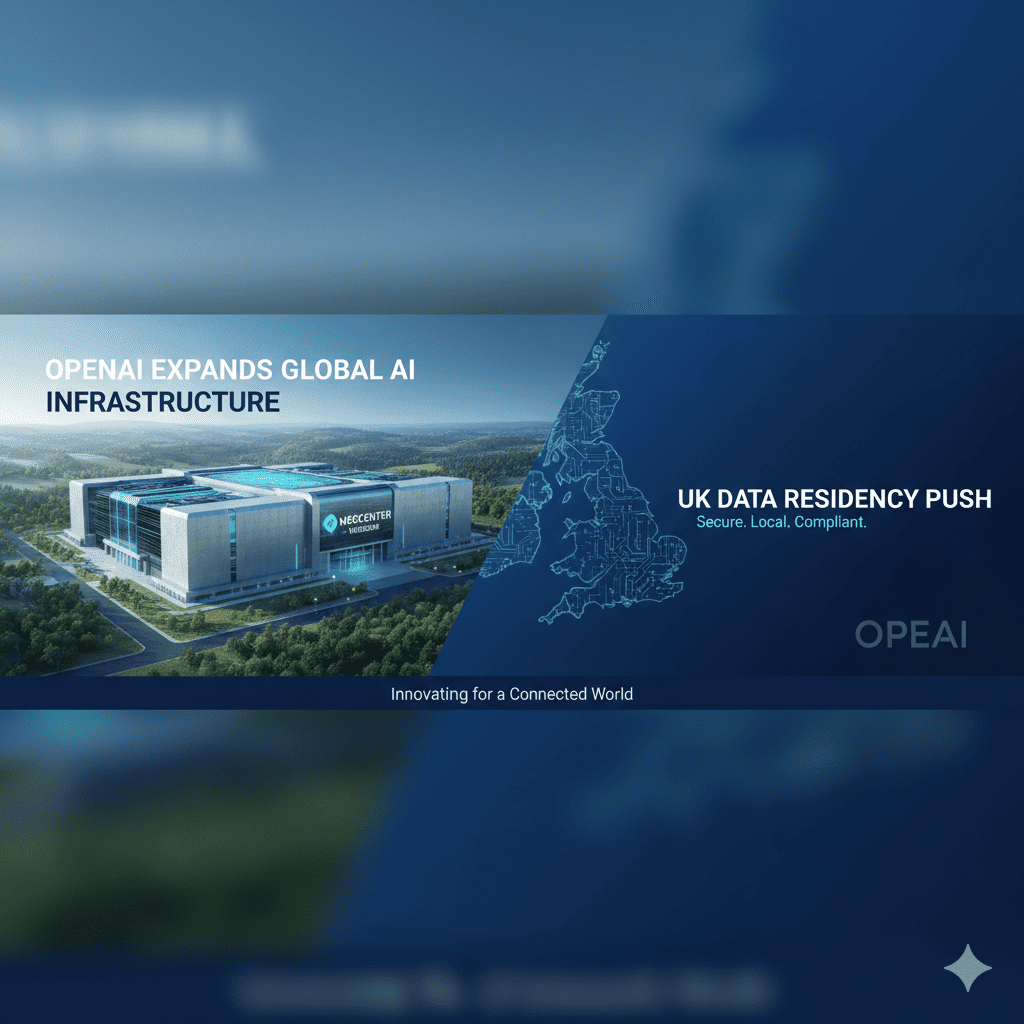
Artificial Intelligence (AI) is no longer confined to software updates and algorithmic breakthroughs — it now has a physical presence, rising in the form of vast data centers and strategic global infrastructure projects. The latest example of this transformation comes from OpenAI, which has announced two major developments: a massive data center project in Wisconsin in partnership with Oracle and Vantage Data Centers, and a new UK data residency option driven by collaboration with the British government.
Together, these announcements highlight a defining trend in AI’s evolution: the race to scale infrastructure while maintaining regional data sovereignty.
The Wisconsin “Stargate” Data Center: A Megaproject for the AI Era
OpenAI’s collaboration with Oracle and Vantage Data Centers is set to reshape the future of AI compute capacity. The new facility, located in Port Washington, Wisconsin, will be part of the “Stargate” initiative — a multibillion-dollar infrastructure program designed to support OpenAI’s next generation of AI models.
Unprecedented Scale and Ambition
According to reports from Reuters and Data Center Dynamics, the campus will deliver nearly 1 gigawatt (GW) of capacity spread across four interconnected data centers. Construction is expected to continue through 2028, making it one of the largest AI-focused data infrastructure projects ever undertaken in the United States.
This scale reflects the enormous compute demands of large language models (LLMs) like GPT and other generative AI systems. Training and deploying these models require vast amounts of energy, cooling, and networking power — something only a handful of global tech partnerships can deliver.
Oracle’s role is particularly crucial here. Its cloud infrastructure will serve as the technological backbone, providing the compute and storage layers necessary for OpenAI’s growing product ecosystem, including ChatGPT, DALL·E, and enterprise solutions.
Sustainability and Green Innovation
Beyond scale, sustainability is at the heart of the Wisconsin project. Vantage Data Centers has committed to zero-emission energy matching, water-positivity, and biodiversity net gain in the design. The site will incorporate closed-loop liquid cooling and renewable energy integration to reduce environmental impact.
This focus aligns with a broader industry trend. As AI infrastructure expands, so do concerns about power consumption and environmental sustainability. Global AI workloads are projected to consume more than 10% of the world’s electricity by 2030 if not managed responsibly. The Wisconsin campus represents an effort to address these concerns from the outset.
Economic and Geopolitical Impact
On a regional level, the project is expected to generate thousands of construction jobs and inject billions into the local economy. Strategically, it places Wisconsin on the map as a hub for global AI infrastructure, competing with existing tech clusters in Virginia, Texas, and California.
Globally, this signals a shift toward infrastructure-driven AI competition. Countries and corporations alike are racing to build the physical foundation of artificial intelligence — data centers, chip fabrication facilities, and power systems capable of sustaining the exponential growth of machine learning.
OpenAI’s UK Data Residency Option: Sovereignty in the AI Age
While the Wisconsin project represents expansion at scale, OpenAI’s second announcement reflects a different but equally important aspect of AI’s future — data sovereignty and trust.
From October 25, OpenAI will begin offering a UK data residency option for its enterprise products, including ChatGPT Enterprise, ChatGPT Edu, and the OpenAI API platform. This means that UK government and corporate data can be stored and processed entirely within the United Kingdom, rather than being routed through global cloud servers.
A Government-Backed Partnership
This initiative comes through a formal partnership with the UK Ministry of Justice (MoJ) and other government departments. More than 2,500 civil servants are expected to gain access to ChatGPT Enterprise tools under this collaboration, making it one of the first large-scale governmental deployments of generative AI in Europe.
The move demonstrates the UK’s commitment to building sovereign AI capabilities — ensuring that data, especially sensitive or public-sector information, remains under domestic control. For OpenAI, it marks a strategic shift toward localized infrastructure that complies with regional data laws like the UK GDPR.
Why Data Residency Matters
Data residency has become a cornerstone of enterprise AI adoption. As organizations increasingly rely on AI for decision-making and operations, questions of where data lives — and who can access it — have become critical.
By offering UK data residency, OpenAI provides businesses and government agencies the assurance that their data will not cross borders or fall under foreign jurisdictions. This capability is essential for sectors such as healthcare, finance, and public administration, where privacy and compliance are paramount.
Broader Implications for Global AI Strategy
This announcement is more than a compliance update — it represents a strategic realignment of AI infrastructure. The world’s largest AI companies are transitioning from global, cloud-based models to regionally distributed systems that can adapt to local laws, cultural expectations, and geopolitical realities.
For the UK, this partnership strengthens its role as a European AI hub and aligns with its broader national AI strategy. For OpenAI, it opens new markets and deepens trust with government and enterprise clients across Europe and beyond.
Two Moves, One Message: The Globalization of AI Infrastructure
OpenAI’s Wisconsin and UK projects might seem different — one focuses on physical scale, the other on regulatory precision — but they share a common goal: building the next-generation infrastructure for trustworthy, scalable AI.
1. The Physical Expansion of AI
The Wisconsin “Stargate” data center underscores how AI’s growth depends on vast physical resources — power, cooling, chips, and space. As AI models grow from billions to trillions of parameters, data centers are becoming the new factories of the digital age.
2. The Localization of AI
The UK data residency option highlights a complementary trend: the localization of AI services. As governments demand greater control over digital assets, global AI providers must adapt with regionally compliant solutions.
This dual strategy — scaling globally while localizing regionally — will likely define AI’s next decade
What It Means for Businesses and Governments Worldwide
Enterprises will increasingly evaluate AI providers based on where data is stored and how infrastructure is managed.
Governments will seek sovereign partnerships to ensure that public-sector data remains secure.
Developers and startups may gain new opportunities as AI infrastructure expands to new regions, creating ecosystems of innovation around these data centers.
Environmental advocates will monitor sustainability commitments, ensuring that growth in AI does not come at the cost of ecological balance.
For emerging economies like India, these developments carry important lessons. As AI adoption grows domestically, there will be rising pressure to build localized compute and data storage capacity — ensuring compliance, resilience, and competitiveness in the global AI economy.
Conclusion: Building the Foundations of the AI Future
OpenAI’s latest moves — the Stargate data center in Wisconsin and the UK data residency program — symbolize the next stage of AI’s industrial revolution. AI is no longer just software running in the cloud; it’s a vast, interconnected infrastructure spanning continents, data laws, and energy systems.
These developments mark a turning point in how nations, companies, and individuals will engage with artificial intelligence. The future of AI will depend not just on smarter algorithms but on where those algorithms live, how they’re powered, and who controls their data.
In short, OpenAI is not just training models anymore — it’s building the physical and regulatory backbone of global intelligence.