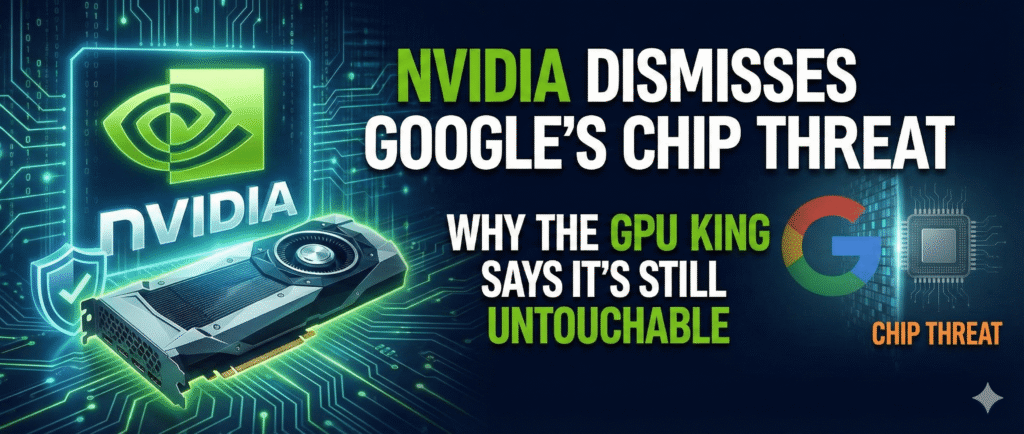
The global AI chip battle intensified this week as Nvidia responded to growing chatter about Google’s rising influence in the semiconductor arena. After reports surfaced that Meta may partner with Google to use its TPU (Tensor Processing Unit) chips starting 2027, Nvidia’s stock temporarily dipped — prompting the company to make a rare public statement.
But instead of sounding defensive, Nvidia dismissed the situation, saying Google’s chip advancements are not a real threat to its leadership.
🔥 What Triggered the Tension?
A series of reports suggested:
Meta is in talks with Google to adopt TPUs for large-scale AI workloads.
This could divert a portion of Meta’s huge GPU orders away from Nvidia.
Investors reacted quickly, pushing Nvidia’s shares down and lifting Alphabet’s stock.
With Nvidia dominating over 80% of the AI chip market, anything hinting at competition naturally attracts attention.
Nvidia’s Response: “We’re Still Generations Ahead”
Nvidia brushed aside concerns, stating that:
1️⃣ GPUs Are Still More Powerful & Flexible
Nvidia highlighted that GPUs work across all types of AI tasks — training, inference, multimodal models, robotics, simulation, edge computing, and more.
TPUs, meanwhile, are specialized and optimized for narrower workloads.
2️⃣ CUDA Is a Massive Advantage
For more than a decade, Nvidia has built a strong ecosystem of software (CUDA), tools, libraries, model optimizations, and developer support.
Switching this entire ecosystem to TPUs would be a huge engineering challenge for any company.
3️⃣ Adoption Takes Time
Even if Meta or others show interest in TPUs, large-scale integration, testing, and production timelines mean Nvidia’s near-term dominance remains secure.
In short, Nvidia argued that while competition exists, no one is close enough to replace its platform.
🟥 But Why Google Is Still a Serious Rival
Even with Nvidia’s confidence, Google’s TPU strategy has some strengths:
Lower cost and higher efficiency for specific AI workloads
Deep integration with Google Cloud, making deployments seamless
Strong appeal for tech giants focused on cost reduction at scale
If Meta adopts TPUs in bulk, it could open the door for other giants like OpenAI, Anthropic, or Amazon to consider alternatives.
This wouldn’t dethrone Nvidia overnight — but it could begin reducing the dependency on GPUs in the long run.
🔮 What’s Next in the AI Chip War?
The Nvidia vs Google rivalry signals a broader shift in the AI chip landscape:
Companies want more suppliers instead of relying solely on Nvidia
Cloud providers are building their own chips to cut long-term costs
AI workloads are expanding so fast that the market may support multiple winners
For now, Nvidia remains the clear leader.
But Google’s acceleration — backed by hyperscale adoption — may slowly reshape the competitive field.
📝 Final Thoughts
Nvidia may confidently dismiss Google’s chip threat today, but the competitive energy in the industry is unmistakable. As AI models become more advanced and infrastructure demand skyrockets, tech giants are aggressively seeking alternatives.
The next few years will shape whether Nvidia maintains its near-monopoly — or whether TPUs and custom silicon rise to challenge the king.