As the world moves rapidly toward digital transformation, data centers have become the backbone of the global economy. From AI model training and cloud services to online banking and streaming—everything runs on massive computing infrastructure.
But this advancement comes with one major challenge: power.
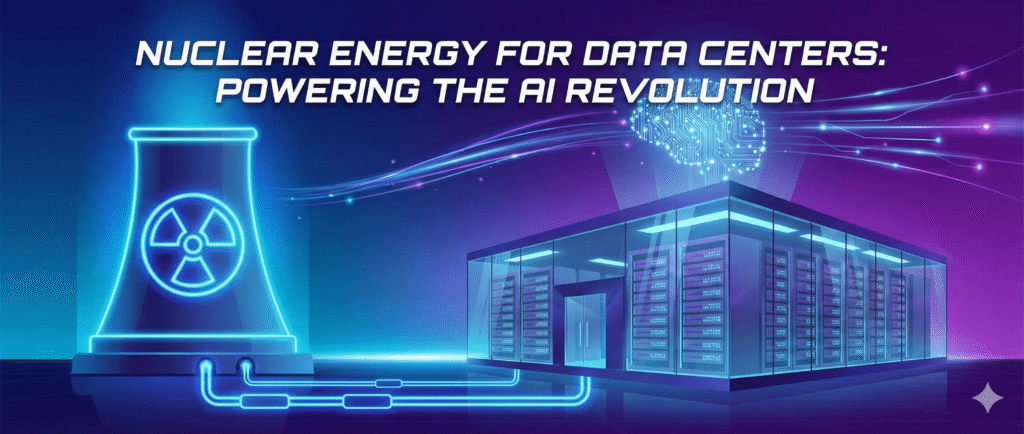
Modern data centers consume enormous amounts of electricity, and traditional energy sources are struggling to meet this rising demand. This is why the industry is now turning toward a powerful, stable, and clean alternative—nuclear energy.
Why Data Centers Need Nuclear Power
1. Explosive Growth in Power Demand
AI workloads, GPU clusters, hyperscale cloud systems, and high-performance computing (HPC) now require 4–10 times more electricity than traditional data centers.
With AI adoption skyrocketing, the power requirement will only continue to grow.
2. Reliable 24/7 Baseload Power
Nuclear energy is the only major source that provides:
uninterrupted, stable electricity
weather-independent power generation
long-term reliability
Unlike solar and wind—which depend heavily on weather—nuclear reactors operate continuously for months and even years without interruption.
3. Low-Carbon and Eco-Friendly
Tech companies are under pressure to meet net-zero goals. As AI systems consume more energy, carbon emissions rise rapidly.
Nuclear energy offers a clean, zero-emission solution that keeps sustainability commitments intact.
SMRs: The Next Big Breakthrough in Nuclear-Powered Data Centers
One of the most exciting advancements in modern nuclear technology is the development of Small Modular Reactors (SMRs).
What makes SMRs ideal for data centers?
Compact size
Lower installation and operational cost
High safety standards
Minimal maintenance
Ability to provide 24/7 clean energy for decades
Global tech giants like Microsoft, AWS, and Google are exploring SMRs to power next-generation AI campuses.
Why the Shift Toward Nuclear Energy Is Accelerating
✔ AI’s massive electricity consumption
A modern AI data center can demand 1–3 gigawatts of power—equivalent to the electricity usage of a small city.
✔ Grid capacity limitations
In many countries, existing power grids cannot expand fast enough to support large-scale AI data centers.
✔ Government support and policies
Nations like the US, Japan, and those in Europe are providing incentives and fast-tracking approvals for advanced nuclear technologies.
Challenges Ahead
While nuclear energy looks promising, there are still hurdles:
lengthy regulatory approval processes
high upfront investment
public concerns regarding safety
However, innovations like SMRs and advanced reactor designs are expected to reduce these limitations significantly by 2030.
What Does the Future Look Like?
The future of data centers is closely tied to the future of nuclear energy.
With the rise of AI, GPU-intensive workloads, and real-time digital services, companies are preparing for a new era of energy-hungry computing.
Nuclear-powered data campuses, on-site micro reactors, and hybrid nuclear-renewable grids will likely become standard in the coming decade.
Conclusion
As AI continues to scale, the world needs a reliable and clean energy solution—and nuclear power stands out as the most powerful option.
It offers unmatched stability, near-zero emissions, and the capacity to fuel the next wave of global innovation.
Nuclear energy is not just an alternative—it’s the future of data center power.