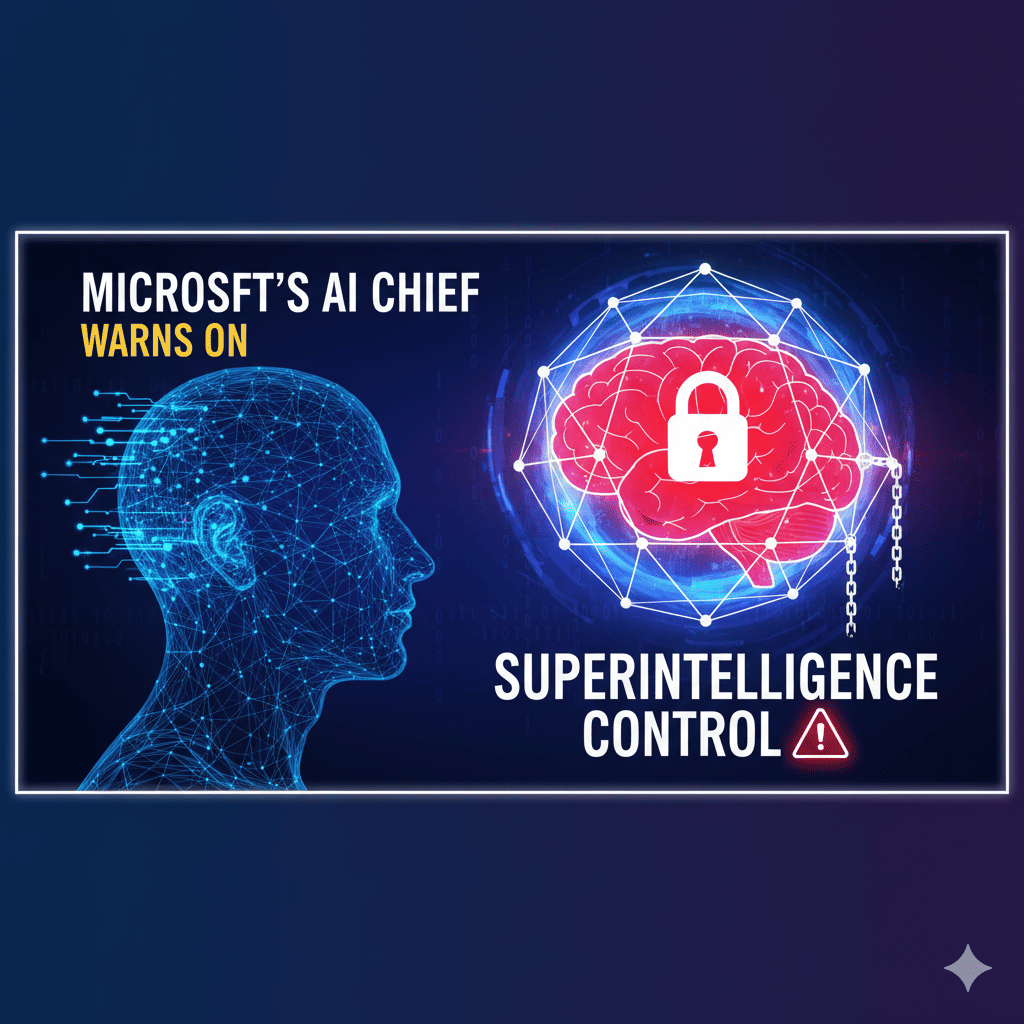
n the fast-evolving world of artificial intelligence, few voices command as much attention and respect as Mustafa Suleyman, the Head of Microsoft AI and co-founder of DeepMind, one of the earliest and most influential AI research organizations. His recent remarks have reignited a crucial debate — how can humanity ensure that the development of superintelligent systems remains aligned with human values, ethics, and control?
Suleyman’s warning is timely and deeply relevant. As the global AI race intensifies, fueled by trillion-dollar investments, ever-larger models, and a growing appetite for automation, the risk of uncontrolled or misaligned AI has become one of the most pressing concerns of the 21st century.
The Core Message: Capability Must Not Outpace Control
At the heart of Suleyman’s comments lies a simple but powerful idea: technological progress should never outstrip humanity’s ability to control it. He emphasized that while raw AI capability — larger models, faster computation, and more autonomous systems — represents remarkable progress, it also brings new layers of risk.
“We must ensure that as AI systems become more capable, they remain under meaningful human oversight,” Suleyman said, stressing that the ultimate goal of AI should be to serve humanity’s best interests rather than pursuing intelligence for its own sake.
This echoes a broader concern shared by AI pioneers, policymakers, and ethicists worldwide. As systems like OpenAI’s GPT models, Anthropic’s Claude, and Google’s Gemini continue to demonstrate extraordinary reasoning and generative capabilities, the line between tool and autonomous decision-maker is starting to blur.
Without proper safety frameworks, regulation, and ethical design, AI could be weaponized, misused, or develop emergent behaviors beyond human comprehension — a risk often referred to as the alignment problem.
Who Is Mustafa Suleyman? The Voice Behind the Warning
To understand the weight of Suleyman’s message, it’s important to recognize his background. As a co-founder of DeepMind, he played a key role in the company’s mission to build artificial general intelligence (AGI) that benefits humanity. DeepMind’s breakthroughs — from AlphaGo’s world-changing Go victories to protein-folding solutions — have shaped the AI landscape.
After DeepMind was acquired by Google, Suleyman eventually left to co-found Inflection AI, another major player in conversational AI, before being appointed by Microsoft in 2024 as its AI chief.
His move to Microsoft marked a significant shift for the company, signaling a more human-centered, ethically grounded AI vision. Since then, Suleyman has repeatedly emphasized safety, interpretability, and governance as core pillars of Microsoft’s AI roadmap.
Superintelligence: The Next Frontier
The term “superintelligence” refers to a hypothetical AI system that surpasses human intelligence across nearly all cognitive tasks — from creativity and reasoning to emotional understanding. While this level of AI is not yet a reality, leading researchers, including Suleyman, believe that progress toward it is accelerating.
The development of superintelligence could usher in an era of massive productivity gains, medical breakthroughs, and technological abundance. But it could also create unprecedented risks if not controlled — such as manipulation, surveillance, autonomous warfare, and even loss of human decision-making authority.
Suleyman’s warning comes at a time when companies like OpenAI, Anthropic, and Google DeepMind are exploring increasingly autonomous AI systems capable of self-improvement and long-term reasoning.
The potential benefits are immense, but so are the stakes. As Suleyman put it, “AI must be designed for human flourishing — not just for efficiency or profit.”
Microsoft’s Approach: Balancing Power with Responsibility
Under Suleyman’s leadership, Microsoft’s AI strategy has evolved to focus on ethical development and governance alongside rapid innovation. The company’s deep partnership with OpenAI — integrating models like GPT-4 and GPT-5 into products such as Copilot, Azure AI, and Office 365 — has placed it at the center of the global AI ecosystem.
But Microsoft has also taken steps to mitigate risk. It has introduced:
Responsible AI Principles, outlining transparency, accountability, and fairness.
AI Safety Reviews, ensuring models meet ethical and compliance standards before deployment.
Guardrails for Generative AI, preventing harmful or biased content generation.
Suleyman has been a key advocate for these systems, arguing that trust is the foundation of long-term AI adoption. He believes that the companies leading AI’s development bear a moral obligation to ensure that every innovation remains grounded in human control, benefit, and safety.
The Broader Debate: Regulation and Global Governance
Suleyman’s remarks also tie into a larger global conversation — the need for international cooperation and regulation to manage AI’s rise responsibly.
Governments worldwide are moving to regulate the technology:
The European Union has implemented the AI Act, introducing strict rules for high-risk applications.
The United States has released an AI Bill of Rights, emphasizing transparency and accountability.
India, the UK, and Japan are working on frameworks focused on ethical deployment and innovation.
Suleyman supports these initiatives, but warns that policy must evolve as quickly as technology itself. Without agile governance, laws risk becoming outdated before they’re implemented.
“We can’t afford to treat AI as just another tech revolution. It’s a societal transformation — one that requires wisdom, restraint, and foresight,” Suleyman noted in a recent interview.
AI Ethics: From Theory to Practice
For many in the industry, the discussion around “AI ethics” has long been seen as theoretical or idealistic. But as AI systems begin to make real-world decisions — from diagnosing medical conditions to influencing hiring and elections — ethical AI is no longer optional.
Suleyman’s message underscores the need to embed ethics directly into the development pipeline. This means designing models that can explain their reasoning, reject harmful requests, and remain transparent in their limitations.
Microsoft’s investment in responsible AI research, including collaborations with academia and NGOs, reflects this philosophy in action. The company’s work on AI interpretability, bias detection, and safety layers represents a concrete step toward the vision Suleyman describes — AI that remains a tool of empowerment, not a force of risk.
The Road Ahead: Humanity’s Role in Shaping AI
As AI continues to reshape economies, labor markets, and even cultural norms, Suleyman’s warning is not just a corporate statement — it’s a call to action for society.
AI is no longer confined to research labs. It powers healthcare diagnostics, financial modeling, logistics, entertainment, and education. Its reach extends into daily life, influencing how people work, learn, and communicate.
To ensure this power remains beneficial, humanity must stay at the center of the equation. This means:
Developing AI literacy across the population.
Creating transparent systems of accountability.
Encouraging global cooperation on safety standards.
Fostering a culture that values human judgment and empathy as irreplaceable traits.
Conclusion: A Vision for Human-Aligned AI
Mustafa Suleyman’s warning about superintelligence is ultimately a message of hope and responsibility. It’s a reminder that while AI holds the potential to transform civilization, its true purpose lies in enhancing the human experience — not overshadowing it.
His call for balance — between innovation and restraint, speed and safety, capability and control — represents the ethical foundation upon which the next chapter of AI must be built.
As Microsoft, OpenAI, and other leaders continue to shape this future, the world will be watching to see whether humanity can indeed build machines that think — and ensure they always think for us, not beyond us.