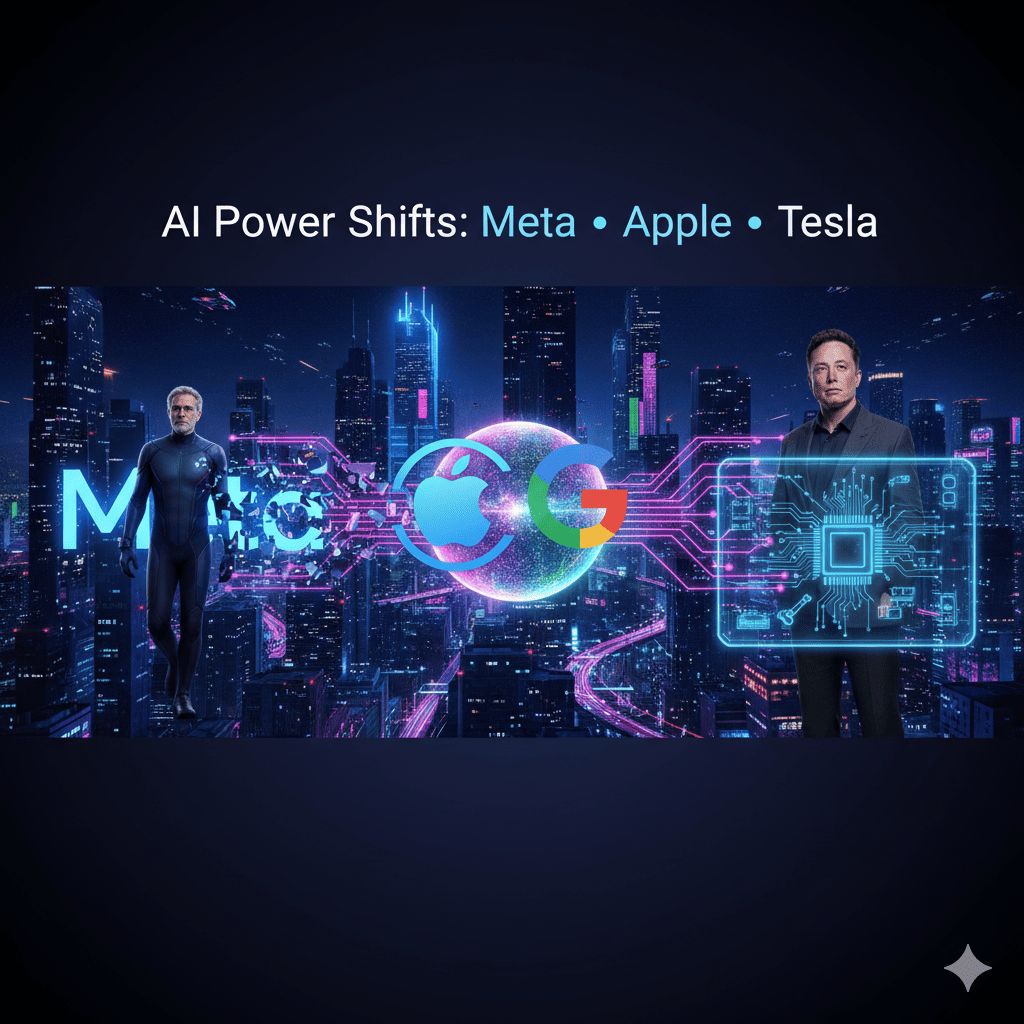
The artificial intelligence (AI) world is buzzing with major developments — from leadership shakeups to unexpected partnerships and bold manufacturing ambitions. This week, reports suggest that Meta’s Chief AI Scientist Yann LeCun may leave to start his own company, Apple is collaborating with Google to supercharge Siri, and Tesla CEO Elon Musk is considering building an in-house semiconductor fabrication plant to meet growing AI chip needs.
Let’s unpack what each of these stories means for the future of AI and the broader tech industry.
1. Yann LeCun’s Possible Exit from Meta: A New Chapter in AI Research
Yann LeCun, Meta’s Chief AI Scientist and one of the “Godfathers of Deep Learning,” is reportedly planning to leave Meta to launch his own AI startup. Sources suggest his new company will focus on developing “world models” — AI systems capable of understanding and reasoning about real-world environments, going beyond today’s text-based language models.
LeCun has long been a vocal critic of over-reliance on large language models (LLMs), arguing they are not the best path toward human-level intelligence. His departure could mark a philosophical divide in the AI community — between those chasing ever-larger LLMs and those exploring alternative architectures like world models and embodied AI.
Meta, meanwhile, continues restructuring its AI division to focus more on product-driven advancements and commercial applications, potentially signaling a shift away from long-term exploratory research.
Impact: LeCun’s exit could lead to a new wave of independent AI innovation and startups centered on real-world intelligence rather than pure text prediction. It may also push Meta to rethink how it balances foundational research with short-term product goals.
2. Apple’s Big Move: Revamping Siri with Help from Google AI
In a surprising twist, Apple is reportedly partnering with Google to power a new version of Siri using a customized version of Google’s Gemini AI model. This collaboration could mark one of Apple’s most significant strategic partnerships in recent years.
The upgraded Siri will reportedly leverage a model with 1.2 trillion parameters — a massive leap from Apple’s current in-house AI systems. The plan aims to make Siri far more conversational, context-aware, and capable of handling complex user queries.
Apple is expected to host the model on its Private Cloud Compute infrastructure to maintain privacy and control over user data, even while licensing Google’s technology. The rumored deal could be worth around $1 billion per year for Apple.
Why It Matters:
Apple has long been criticized for letting Siri fall behind competitors like Google Assistant and Alexa. This partnership signals a new era of pragmatism — where Apple prioritizes user experience over total independence.
For Google, it’s a strategic win — expanding Gemini’s reach into millions of Apple devices.
What’s Next:
Apple’s next iOS update may showcase the reimagined Siri experience, merging Apple’s design and privacy ethos with Google’s AI muscle.
3. Tesla’s Bold Plan: Building Its Own AI Chip Factory
During Tesla’s recent shareholder meeting, CEO Elon Musk revealed that the company may need to build its own semiconductor fabrication plant to meet the growing demand for AI chips.
Tesla’s AI operations — including self-driving systems, humanoid robots, and Dojo supercomputers — require a staggering volume of high-performance chips. Musk stated that even top-tier suppliers like TSMC and Samsung might not be able to keep up with Tesla’s projected needs, suggesting a future “Terafab” plant under Tesla’s control.
However, industry experts, including Nvidia CEO Jensen Huang, cautioned that building a modern chip fab is “an extremely hard challenge” — requiring massive investment, technical expertise, and years of development.
Impact:
If Tesla proceeds, this could transform the semiconductor landscape. An in-house fab would give Tesla greater control over its AI hardware, reduce supply chain risks, and strengthen its competitive edge in robotics and autonomous driving.
It would also align with the broader trend of tech giants pursuing vertical integration to secure critical AI infrastructure.
The Bigger Picture: The AI Race Is Entering a New Phase
These three stories highlight a defining shift in the global AI landscape:
Talent Independence: Top AI leaders like LeCun are branching out to pursue new ideas beyond corporate R&D structures.
Cross-Company Collaboration: Apple and Google’s partnership shows how rivals may unite in the race for smarter assistants.
Hardware Sovereignty: Tesla’s exploration of chip manufacturing underscores how AI ambitions now extend deep into physical infrastructure.
Each move — from Meta’s internal shakeups to Apple’s collaboration and Tesla’s potential fab — points to a single truth: the AI race is no longer just about algorithms; it’s about ecosystems, partnerships, and control over the entire stack — from data to silicon.
Final Thoughts
Artificial intelligence is evolving faster than ever. As 2025 unfolds, we’re witnessing a clear trend — major tech companies aren’t just competing to build the best AI models; they’re redefining the boundaries of what it means to innovate.
From LeCun’s new research direction to Apple’s AI-powered Siri revival and Tesla’s push toward semiconductor independence, the message is clear:
👉 AI’s future will belong to those who control both the brains (models) and the machines (chips) that power them.