
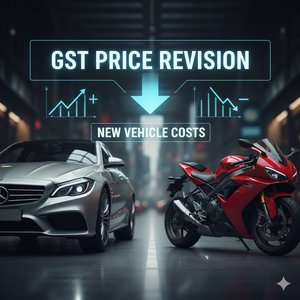
The implementation of the Goods and Services Tax (GST) in India has directly impacted the automobile sector. Vehicles like cars and bikes are a vital part of the average person’s life. Whenever there’s a change in the tax structure, it’s reflected directly in their prices. Recently, the government made some changes to GST rates, and the impact can be clearly seen in bike and car prices.
In this blog, we will learn in detail how the new GST changes have affected the auto sector, what kind of difference has occurred in the prices of bikes and cars, and what benefits or losses will the common consumer get from this.
Relationship between GST and Automobile Sector
Before the implementation of GST, vehicles in India were subject to various taxes such as excise duty, road tax, VAT, and registration fees. The combined cost of these taxes significantly increased the vehicle’s price.But with the introduction of GST, the tax structure became uniform. Today, vehicles are subject to a basic GST rate plus a cess.
Bikes and scooters → Generally fall in the 12% to 28% GST slab.
Cars → Small cars are charged 28% GST + cess, and luxury/SUV cars are charged 28% GST + up to 22% cess.
Recent GST Rate Changes
The government recently changed the tax structure on certain categories of vehicles in the GST Council meeting.
Bikes (with engine less than 150cc) → GST rates have been slightly reduced to make two-wheelers affordable for the common man.
Electric bikes and cars (EVs) → were already subject to 5% GST, and tax incentives are on the way to further promote EVs.
Cars (SUVs and Luxury) → Cess on big engine and luxury cars has been increased to increase revenue.
Impact on bikes
Commuter Bikes & Scooters
Due to the reduction in taxes on 100cc–150cc engine bikes like the Hero Splendor, Honda Shine, TVS Jupiter, etc., prices are seeing a reduction of approximately ₹1,000–₹3,000.
This will make it easier for the middle-class and students to buy a bike.
Premium bikes.
Bikes above 200cc (KTM, Royal Enfield, Yamaha R15) were not affected much as they already attract higher GST rates.
Electric scooters and bikes
The GST on EVs like Ola, Ather, and Bajaj Chetak is already 5%, and there has been no change.
The government may provide further tax concessions to promote the EV sector.
Impact on cars
1 – Small cars (hatchbacks and compact sedans)
Cars like the Maruti Alto, Swift, and Hyundai i20 have a similar tax structure, but manufacturers are now trying to keep prices stable.
Slight stability or a slight decline in prices may be observed here.
2- SUVs and luxury cars
The increased cess on large-engine SUVs like the Toyota Fortuner, Mahindra Scorpio-N, and luxury brands (BMW, Mercedes, Audi) could increase prices by ₹50,000 to ₹2 lakh.
This will certainly impact the high-end car market.
3 – Electric cars
Cars like the Tata Nexon EV, MG ZS EV, and Hyundai Kona are subject to a 5% GST rate. Their prices will remain stable.
EV buyers still enjoy tax benefits.
Impact on consumer
1- Middle class and students → Buying bikes and scooters has become cheaper, which may increase sales.
2 – Luxury car buyers → Now they will have to pay more taxes, so cars will be more expensive for them.
3- EV buyers → No additional burden, but incentives and tax breaks continue.
Impact on automobile industry
1 – Two-wheeler market → The tax cut will boost sales. This will have a positive impact in rural areas.
2- Passenger Car Market → Sales of small and mid-range cars will remain stable, but rising prices in the SUV and luxury segments may dampen demand.
3- EV मार्केट → सरकार EV को लगातार प्रोत्साहित कर रही है, इसलिए इस सेगमेंट की ग्रोथ तेज़ रहने की संभावना है।
Conclusion
The GST rate change in India is directly affecting bike and car buyers.
1- While small engine bikes and scooters have become a little cheaper, luxury SUVs and big cars have become more expensive.
2- Tax exemptions for electric vehicles continue, giving a boost to the EV market.
The government’s goal is to provide relief to the general public while also increasing revenue by levying higher taxes on luxury cars. Further GST reductions cannot be ruled out in the future to further promote EVs. If you are thinking of buying a new vehicle, it is important to understand how the GST changes will affect the price of your favourite bike or car.