🔹 Introduction
A new phase has now begun in the global tech market—one where AI, semiconductors, and digital regulations have converged.
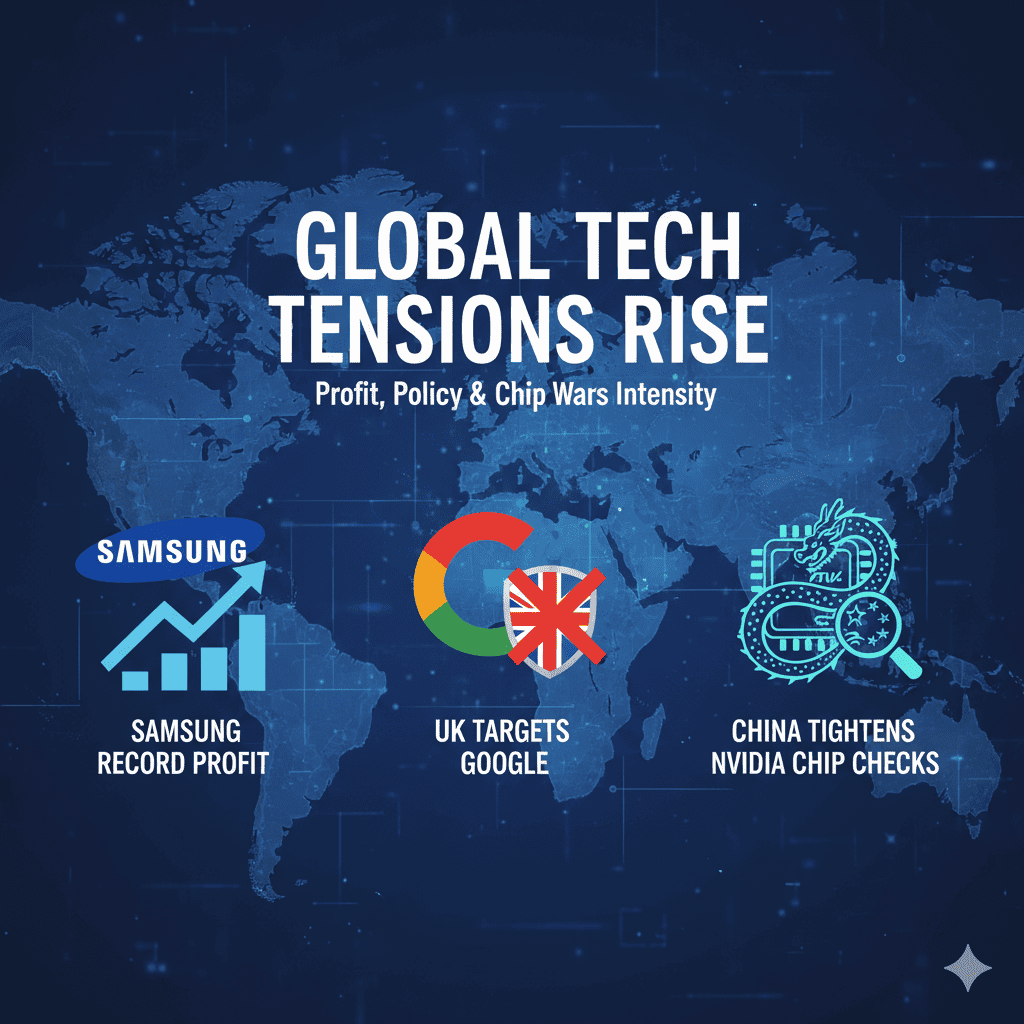
In the first half of October 2025, three major news stories captured global headlines:
Samsung’s record Q3 profit,
UK’s regulatory action against Google,
and China’s crackdown on Nvidia chips.
These three stories together paint a stark picture—of global tech politics and power struggles amid the AI boom.
Samsung's record-breaking profits - boosted by chip demand
South Korean tech giant Samsung Electronics surprised everyone with its Q3 results. The company estimated an operating profit of approximately ₩12.1 trillion (around $8.5 billion)—a 32% increase from the previous year.
📈 Reason: Memory Chip Demand Explosion
The growing use of AI has pushed the demand for memory chips in data centers and servers to record levels.
Prices of DRAM and NAND chips have risen by 170%—a core business segment for Samsung.
Server companies and cloud giants like Microsoft Azure, Amazon AWS, and Google Cloud are ordering heavy memory chips for AI workloads.
⚙️ Samsung vs. HBM Competition
Yes, Samsung still lags behind Nvidia and SK Hynix in HBM (High Bandwidth Memory) chips, but its commodity memory segment is so strong that it is covering those losses.
💡 Expert View
Analysts say the memory market is now emerging from its downturn—but the challenge is how long this momentum can last.
If AI demand remains stable, this could be a long-term win for Samsung.
🇬🇧 UK vs Google — New Rules on Search Market
The UK government has taken a historic step against Google.
The UK’s Competition and Markets Authority (CMA) has granted Google “Strategic Market Status” (SMS)—meaning they now have direct regulation powers over Google’s search business.
🧩 What is “Strategic Market Status”?
It simply means—Google is such a large and influential platform that it impacts digital competition.
The CMA now has the power to set rules to ensure fairness in Google’s search and ad services.
🧭 Possible Changes
Choice Screens: UK users will have the option to self-select their default search engine (e.g., Bing, DuckDuckGo, or Ecosia).
Fair Ranking: Google cannot unfairly rank its own products (Maps, YouTube, etc.) at the top.
Publisher Rights: News publishers and creators are demanding more control over the use of their content in AI summaries.
Data Portability: It may be easier for new search startups to connect to Google’s data ecosystem.
⚖️ Google’s Response
Google says such rules could slow innovation and delay product rollouts in the UK.
But regulators believe this step is necessary to break digital monopolies and foster healthy competition.
🇨🇳 China Tightens Nvidia Chip Inspections
Now let’s move on to China—where a new twist has emerged regarding AI chip imports.
China has tightened customs inspections on Nvidia’s AI chips at its major ports.
🔍 What’s Happening?
Chinese customs officers are clearing Nvidia chips like the H20 and RTX Pro 6000D only after strict checking.
This crackdown is primarily on chips designed under U.S. export restrictions.
Now reports are saying that scrutiny has increased on all advanced semiconductor products.
🧠 The Bigger Picture
This move is part of China’s long-term goal—reducing foreign technology dependency and growing its domestic semiconductor ecosystem.
Chinese companies like Baidu, Alibaba, and ByteDance have also been asked to delay new chip orders from Nvidia.
⚠️ Impact on Nvidia
This is a major risk for Nvidia—as China is a major market for them.
This crackdown will increase pressure on both their sales and delivery timelines.
The global AI chip supply chain and geopolitics are both becoming more complex.
🌐 The Global Connection — AI, Chips, and Regulation
If these three stories are viewed together, a clear trend emerges—
AI has shifted the tech balance of power around the world.
🔸 Samsung’s Story
The expansion of AI infrastructure revived the memory chip market—and brought South Korea back to the top of the global chip race.
🔸 Google’s Story
AI-based search results and summarization have alerted regulators—that fair competition is in danger if one company has so much data and influence.
🔸 China’s Story
AI and chip technology have now become a national security issue.
U.S. restrictions and Chinese counteractions are intensifying the tech cold war.
📊 What to Expect Next
Samsung Earnings Release:
Investors are eagerly watching which segment brought profits—memory chips, displays, or smartphones.
1 -UK’s Final Regulation Framework:
When and how the CMA will implement its new rules—this will be decisive for Google’s future.
2 -China-U.S. Tech Tensions:
Nvidia and other U.S. chipmakers may find it more difficult to do business in the Chinese market.
3 -AI Ecosystem Shifts:
Both the global supply chain and regulatory environment for AI are taking shape—this will determine who holds AI leadership over the next decade.
🧭 Conclusion
This quarter of 2025 is a reminder that technology is not just about innovation, but also about power and politics.
Samsung is fueling the AI economy with its chips,
The UK is fighting for fair digital competition,
and China is securing its tech sovereignty.
That means profits and progress on one side—and power and protectionism on the other.
In this age of AI, data, chips, and regulations have become the new weapons.