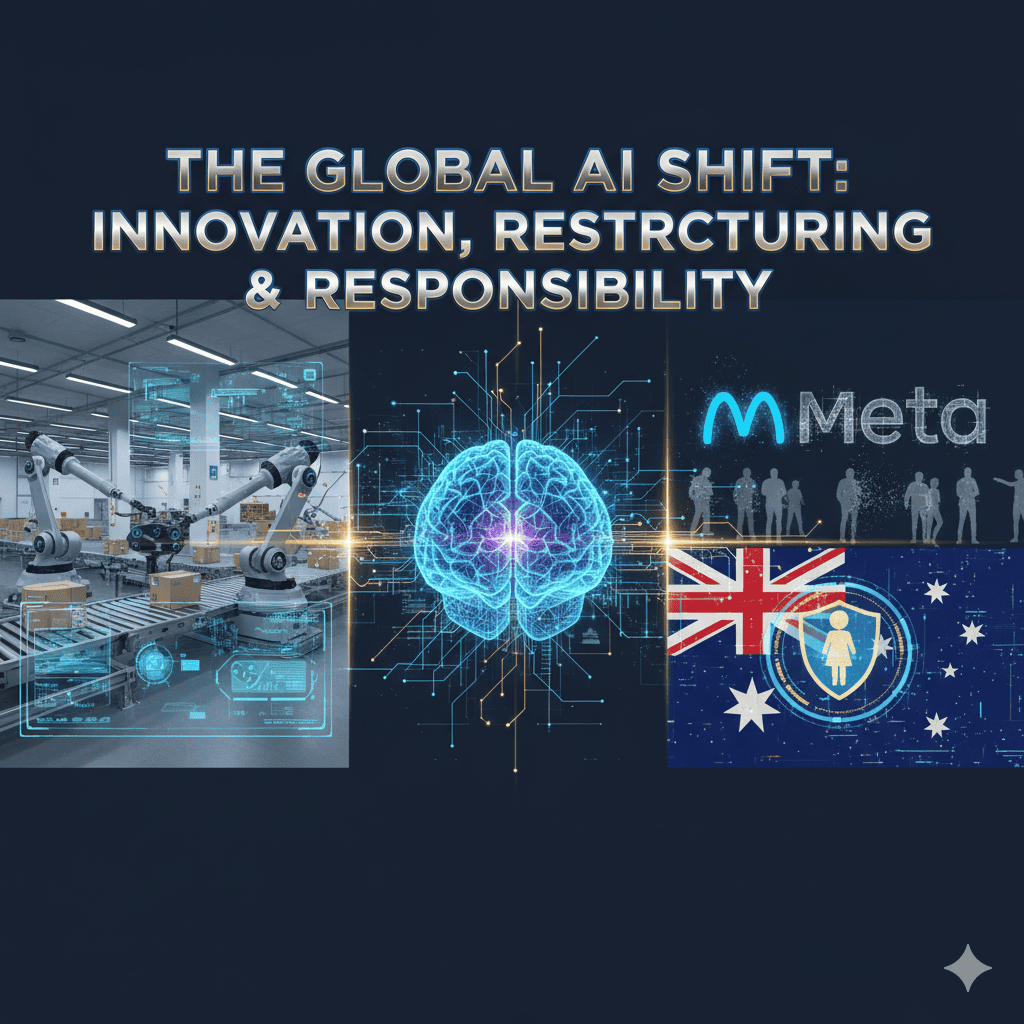
Artificial Intelligence continues to reshape industries — from warehouses to social media labs and even child protection policies. This week, three major developments made global headlines: Amazon’s unveiling of next-gen AI warehouse systems, Meta’s job cuts in its AI division, and Australia’s move to enforce child safety transparency among chatbot companies.
Let’s dive into what’s happening, why it matters, and what it means for the future of AI.
🏭 Amazon’s AI-Powered Warehouse Revolution
Amazon has taken a major leap toward creating the “warehouse of the future.” The company recently introduced a set of AI-driven robotics and automation technologies that promise to enhance delivery speed, efficiency, and safety.
Key Technologies Unveiled:
Blue Jay Robot System: Coordinates robotic arms to pick and organize items, combining three warehouse stations into one streamlined process.
Project Eluna: An agentic AI system that helps warehouse managers predict and resolve bottlenecks in real time.
“Amelia” Smart Glasses for Drivers: Equipped with augmented reality features for turn-by-turn directions, package scanning, and proof-of-delivery photos — replacing bulky handheld scanners.
Why It Matters:
Amazon claims these innovations will improve productivity and reduce physical strain for workers. However, critics highlight potential concerns over job displacement, as automation could replace thousands of roles in the next decade.
Still, this move cements Amazon’s leadership in logistics automation — a key factor in maintaining its global dominance in e-commerce.
💼 Meta Cuts 600 Jobs in Its AI Division
n a surprising move, Meta (formerly Facebook) has laid off around 600 employees from its Artificial Intelligence division. The affected teams include AI infrastructure, research units (like FAIR), and older product-focused departments.
What’s Behind the Cuts:
Meta’s Chief AI Officer, Alexandr Wang, explained that the decision aims to build “smaller, more agile teams with greater impact.” The company continues to invest heavily in newer, more specialized AI labs, such as its TBD Lab, which focuses on next-generation large language models.
The Bigger Picture:
Meta’s restructuring shows a clear trend in the AI industry — refocusing on core innovation areas rather than maintaining large, generalized teams. While layoffs are never easy, Meta’s strategic pivot suggests it wants to compete more effectively with leaders like OpenAI, Google DeepMind, and Anthropic.
The move also reflects a broader reality: even tech giants must balance innovation with efficiency as the AI race becomes more capital-intensive and competitive.
🇦🇺 Australia Demands AI Chatbot Companies to Reveal Child Protection Measures
n another significant development, Australia’s eSafety Commissioner has directed AI chatbot companies — including global players like OpenAI, Google, and Meta — to disclose how they protect children using their AI platforms.
The directive follows growing concerns that chatbots may expose minors to harmful or inappropriate content, either through unfiltered outputs or malicious misuse.
What This Means:
Companies must submit detailed safety reports outlining safeguards against harmful content, data misuse, and grooming risks.
Australia is the first country to implement such a transparency mandate focused on AI child protection.
The move could set a global precedent, pushing other nations to demand similar accountability from AI providers.
Why It Matters:
As chatbots and virtual assistants become part of everyday life, child safety in AI systems is becoming a policy priority. Governments are no longer content with vague promises of “responsible AI” — they want proof of action.
🌍 What These Stories Tell Us About the Future of AI
These three developments share one message: AI is rapidly evolving, but accountability and adaptation are key.
Amazon is showing how AI can redefine productivity — but must balance automation with human employment.
Meta is learning that scaling AI isn’t just about size, but about focus and agility.
Australia is proving that regulation can be proactive, setting ethical standards for AI before harm occurs.
Together, they highlight both the opportunities and challenges of living in an AI-driven world — one where innovation, jobs, and ethics must coexist
🧩 Conclusion
From smart robots to job cuts and safety laws, the AI ecosystem is entering a new phase — one defined by efficiency, restructuring, and responsibility.
As companies innovate faster, governments and societies must ensure that the benefits of AI are shared safely and fairly.
AI is no longer just a technology — it’s becoming the foundation of how businesses operate and how humans interact with the digital world.