
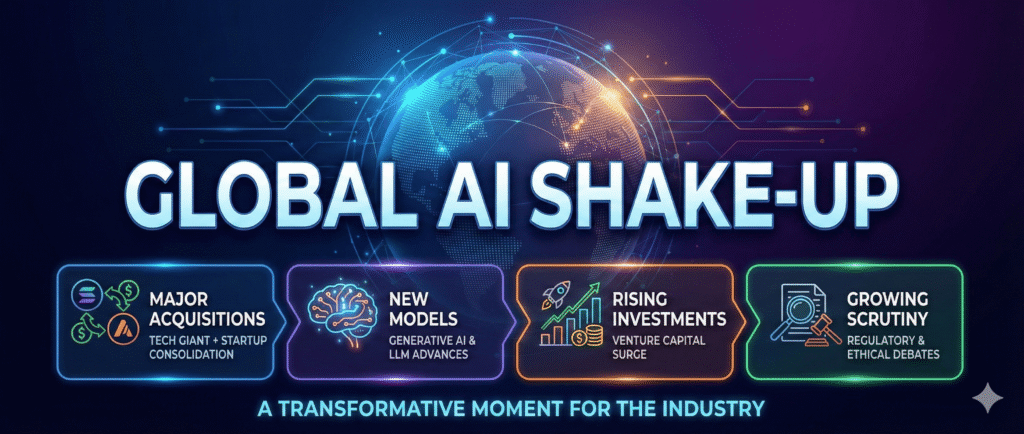
The artificial intelligence ecosystem is undergoing one of its most dramatic shifts ever. From strategic acquisitions and billion-dollar investments to escalating regulatory pressure and rapid model innovation, the last few weeks have highlighted how fast — and how intensely — the AI race is accelerating worldwide.
Tech giants like Anthropic, OpenAI, Google, Nvidia, and ByteDance are setting new industry standards, while newcomers such as DeepSeek are challenging the status quo. At the same time, regulators across multiple continents are questioning how AI systems interact with real-world data.
Here’s a complete breakdown of all the developments reshaping the global AI landscape.
Anthropic Acquires Bun: A Major Step Toward Next-Gen Coding Tools
In a bold move that surprised the development community, Anthropic has acquired Bun, the ultrafast JavaScript runtime known for its lightning-quick bundler, test runner, and package manager. Bun has become a favorite among developers because of its ability to replace Node.js tooling with significantly faster performance.
Why This Matters
Anthropic aims to strengthen its AI-powered coding solutions. By integrating Bun’s tooling:
Claude can offer faster and more accurate code suggestions
AI coding assistants can run code locally with better performance
Anthropic can compete more directly with GitHub Copilot, Google’s Gemini Code Assist, and OpenAI’s advanced coding features
This acquisition signals that AI companies now recognize that developer tooling is a core battleground — not just models.
Marvell Buys Celestial AI: The Chip Wars Expand Beyond GPUs
In the high-performance chip market, Marvell Technology has acquired Celestial AI, a company specializing in photonic interconnects — hardware that uses light instead of electricity for data transmission inside data centers.
Why This Acquisition is Important
As AI models scale, compute is no longer the only bottleneck. Memory bandwidth and interconnect speed are now equally important. Celestial AI’s technology promises:
Higher throughput
Lower latency
Improved energy efficiency
Better scaling for massive AI clusters
This move positions Marvell to compete in a world dominated by Nvidia’s GPUs and networking stack. As AI becomes more power-hungry, alternative architectures like optical computing may become crucial.
OpenAI Doubles Down on ChatGPT Amid Growing EU Scrutiny
OpenAI appears to be shifting its internal priorities. Reports suggest the company is refocusing on improving ChatGPT, deprioritizing larger side projects such as advertising, new enterprise layers, and secondary product lines.
The unexpected pivot comes as the company faces criticism and regulatory pressure — especially in Europe.
EU Investigates WhatsApp AI Integration
The European Union is examining how ChatGPT-powered features inside WhatsApp handle personal data:
Are conversations being stored or processed outside the EU?
How is metadata handled?
Does the integration comply with GDPR?
With privacy regulators paying closer attention, OpenAI must tread carefully as it expands across social platforms.
Massive Funding Continues
Despite scrutiny, OpenAI’s financial momentum is stronger than ever:
Banks are exploring structured funding to support OpenAI’s infrastructure needs
Sify and other data center operators are investing heavily in AI facilities to support GPT workloads
Demand for GPT-5 infrastructure is rising rapidly
It’s a sign that investors expect AI to remain the most profitable technology sector for years.
DeepSeek Releases New Models: The Rising Challenge to Western AI
China’s DeepSeek continues to emerge as one of the most influential AI developments of 2025. The company has released new, lightweight language models that offer:
Competitive accuracy
Faster inference
Lower GPU requirements
Better multilingual performance
These models are gaining traction especially in:
India
Southeast Asia
Africa
Middle Eastern markets
Why It’s Creating Shockwaves
DeepSeek’s models are significantly cheaper to train and run, creating pressure on U.S. tech giants. With global demand shifting toward cost-efficient AI, DeepSeek could eventually redefine how AI infrastructure is priced.
Google Pushes Ahead With Gemini 3: A New Era of Search + AI
Google is preparing its next major launch: Gemini 3, a model designed to unify:
Search
Reasoning
Creation
Multimodal analysis
Assistant capabilities
The company is shifting from a traditional keyword-based search to a deep reasoning engine, positioning Gemini 3 as a “thought partner.”
This is Google’s answer to rising threats from ChatGPT, Perplexity, and open-source models.
Nvidia Continues Hardware Domination as Demand Explodes
Nvidia remains the backbone of global AI infrastructure. From H200 to Blackwell chips, demand for Nvidia GPUs is still outstripping supply.
Key reasons:
Every major AI company relies on Nvidia hardware
Data centers are racing to expand capacity
Enterprise adoption is accelerating across sectors
Nvidia’s stronghold is not just GPUs but its entire ecosystem — CUDA, networking (InfiniBand), and AI software libraries.
ByteDance Emerges as a Global AI Powerhouse
yteDance, the parent company of TikTok, is rapidly becoming one of the most important AI developers in the world. The company is:
Building advanced training clusters
Creating highly efficient AI models
Optimizing training cost and token usage
Designing internal chips for faster performance
Because ByteDance operates at enormous scale, its AI breakthroughs tend to have immediate real-world impact.
Industry-Wide Discussions: Regulation, Energy, and Data Centers
As AI grows, so do concerns.
1. Regulation
Governments worldwide are drafting:
AI transparency rules
Safety requirements for generative AI
Data protection frameworks
Access controls for training datasets
The balance between innovation and oversight is becoming a central global issue.
2. Data Center Expansion
AI requires an unprecedented amount of electricity and cooling. Companies are now:
Building data centers near renewable energy sources
Experimenting with nuclear-powered facilities
Looking toward liquid cooling and advanced thermal designs
3. Chip Supply Chain
Global demand for GPUs, accelerators, and memory chips has become so intense that some companies are facing long-term shortages.
Conclusion: The AI Race Is Entering a New Phase
The recent wave of acquisitions, model launches, and regulatory actions shows that AI is no longer just a technological trend — it’s a geopolitical and economic force.
We are witnessing:
The rise of new challengers (DeepSeek)
The strengthening of giants (Google, Nvidia, OpenAI)
A new battle over developer tooling (Anthropic + Bun)
Accelerating chip innovation (Marvell + Celestial AI)
Growing global regulatory attention
The next six months will likely bring even more breakthroughs — and even more competition — across the entire AI industry.

Если планируете поездку в Калининград, следует заранее узнать, когда идет сезон купания и какая температура моря в Балтийском море у прибрежной зоны города. В июле-августе вода разогревается до комфортных 18-20°C, поэтому окунаться в Калининграде летом действительно реально. При этом, в сентябре и октябре вода уже намного холоднее, и купальный сезон со временем завершается. Найти подробнее о температуре моря, погоде и местах для прогулок можно на сайте калининград какое море омывает .
Вдобавок к пляжей и янтарного побережья, непременно посетите культурные объекты Калининграда: старый город, форты (например, форт 11 — Дёнхофф), исторические замки региона и органный зал в Кафедральном соборе. Для семей с детьми прекрасно подходит светлогорск с музеями и парками, а вечером чудесно зайти в рыбную деревню или наведаться в атмосферные кафе. Калининград приносит приятные впечатления в каждое время года — даже зимой здесь вполне мягкий климат по сравнению с иными частями Россией.