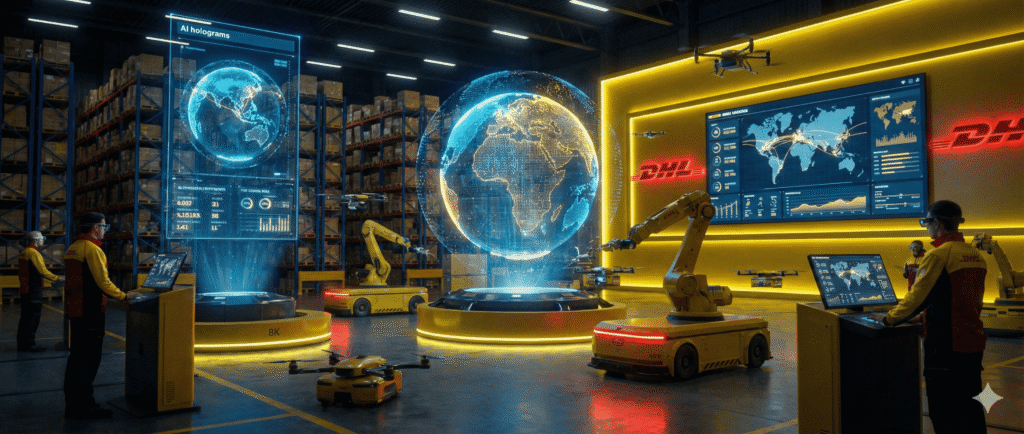
The global logistics industry is changing rapidly, and DHL—one of the world’s largest supply chain and logistics providers—is leading this transformation. Recently, DHL Supply Chain introduced agentic AI agents into its operational ecosystem, marking a major leap forward in automation, efficiency, and customer service.
This move showcases how logistics companies are evolving beyond traditional automation and embracing intelligent, autonomous digital workers capable of handling dynamic, high-volume tasks at scale.
What Exactly Are DHL’s AI Agents?
Unlike ordinary AI chatbots or rule-based automation tools, these new AI agents are autonomous, conversational, and workflow-aware systems. Created in partnership with the AI startup HappyRobot, the agents can manage complex communication tasks that previously required human intervention.
Key capabilities include:
Handling warehouse appointment scheduling
Making follow-up calls to drivers and partners
Managing and responding to emails at large scale
Coordinating high-priority operational tasks
Logging, analyzing, and routing voice calls
Managing exceptions and routing escalations
DHL reports that the AI agents already process hundreds of thousands of emails and millions of voice minutes every year — a previously unmanageable workload without significant human effort.
Why DHL Adopted AI Agents
DHL’s supply chain operations involve massive global networks, time-sensitive deliveries, and a growing volume of daily communications. The implementation of AI agents addresses several major challenges:
1. Boosting Operational Efficiency
The AI agents automate repetitive, rule-based tasks that consume time from human employees. This reduces delays and ensures that processes run around the clock without fatigue or backlogs.
2. Enhancing Workforce Productivity
By lifting the burden of monotonous communication and data-entry tasks, DHL frees its workforce to focus on:
Decision-making
Problem-solving
Customer relationship management
Exception handling
This shift not only increases productivity but also improves job satisfaction.
3. Improving Customer Experience
Customer expectations in logistics are higher than ever. With AI handling communication quickly and consistently, DHL is able to:
Maintain strong service-level agreements (SLAs)
Respond faster
Reduce human errors
Offer 24/7 support
The result is a smoother, more reliable end-to-end supply chain experience.
Agentic AI: The Future of Logistics
DHL’s adoption signals something bigger happening across the logistics and warehousing sectors. Companies are moving beyond simple automation and embracing agentic AI, a new model where AI systems autonomously manage workflows instead of simply assisting humans.
What makes agentic AI different?
It understands the task
It decides the best next action
It executes the workflow
It coordinates across multiple systems
It can interact via voice, email, and chat just like a human
This level of adaptability is a game-changer for supply chain operations where conditions frequently change, and speed is critical.
Impact on the Logistics Industry
DHL’s deployment of AI agents sets a benchmark for other global logistics companies. We can expect significant industry-wide changes in the coming years:
1. Autonomous Warehousing & Transport Coordination
AI agents will take over routine coordination, allowing human teams to focus on supervision and troubleshooting.
2. Faster and More Predictable Deliveries
By reducing communication delays, shipments move faster through each stage of transport.
3. Reduced Operational Costs
Automating communication-heavy tasks dramatically lowers the cost of administrative operations.
4. Stronger Collaboration Across Stakeholders
Suppliers, vendors, drivers, and warehouse teams benefit from consistent, AI-managed communication.
What Does This Mean for DHL Employees?
DHL has emphasized that these agents are not replacing jobs, but rather reshaping them. Employees gain relief from repetitive tasks and can focus on:
Quality control
Strategic planning
Inventory optimization
Safety governance
Technical process oversight
In fact, developing and managing AI workflows results in a more skilled workforce and creates new tech-oriented logistics roles.
What This Means for Customers
For customers, the benefits are simple and powerful:
Faster communication
More reliable scheduling
Better tracking updates
Fewer mistakes
Greater transparency
In industries where delays are costly, AI-driven accuracy becomes a competitive advantage.
Conclusion: DHL’s Biggest Step Toward the Future
DHL’s implementation of agentic AI agents isn’t just an internal upgrade — it’s a milestone in the evolution of global logistics. The shift toward intelligent, autonomous workflows signals a future where supply chains are:
Faster
Smarter
More resilient
Less dependent on manual communication gaps
As the logistics industry moves into a fully AI-augmented era, DHL’s early adoption positions it as a leader, shaping how goods move across the world in the coming decade.