
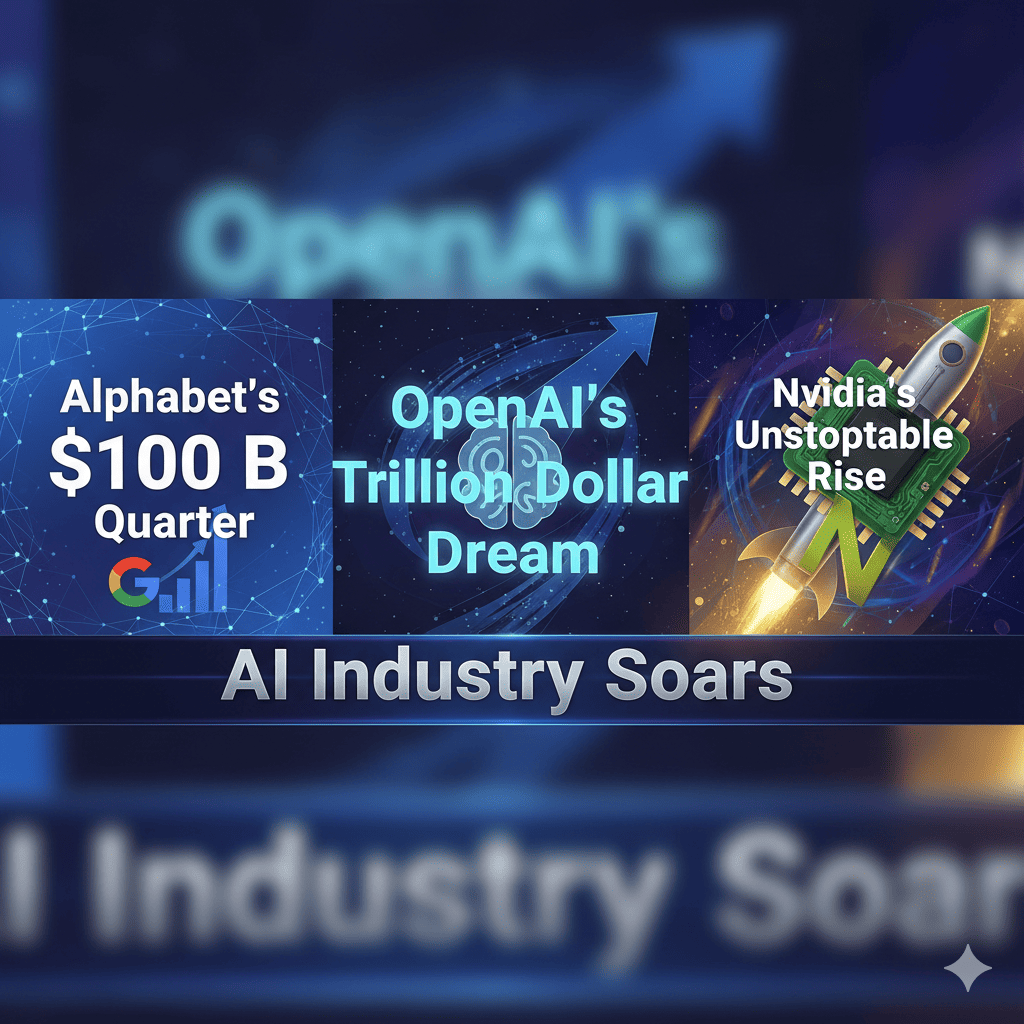
The artificial intelligence (AI) industry is experiencing a remarkable transformation — reshaping global markets, powering massive revenues, and driving trillion-dollar valuations. Over the past few weeks, three tech giants — Alphabet, OpenAI, and Nvidia — have delivered groundbreaking updates that underscore the enormous scale and speed of the AI revolution.
Alphabet Hits Record $100 B Quarter — AI Takes Center Stage
Alphabet, Google’s parent company, just made history by crossing the $100 billion revenue mark in a single quarter for the first time ever. The company reported $102.3 billion in Q3 2025, a 16% year-over-year increase — and much of this success can be credited to AI-driven growth across its ecosystem.
From Google Search and YouTube to Google Cloud, AI is now deeply embedded in every business line. CEO Sundar Pichai highlighted that AI is “driving real business results across the company,” emphasizing how the technology is now a core part of Alphabet’s profitability rather than a future bet.
Google Cloud generated $15.2 billion in revenue, with its backlog of enterprise AI contracts growing 46% to reach $155 billion.
The company is also planning over $90 billion in AI infrastructure investments, signaling how crucial compute power, data centers, and AI tooling are to its future.
Alphabet’s achievement marks a defining moment in the AI era — where AI is no longer a side project or experiment but a primary growth engine for the world’s largest tech companies.
OpenAI Eyes a $1 Trillion IPO — The Biggest in Tech History?
Just as Alphabet celebrates its success, OpenAI is setting its sights on an even bigger milestone — a potential IPO valued at up to $1 trillion. Reports suggest the ChatGPT-maker could go public as early as 2026 or 2027, in what would become one of the largest listings ever.
OpenAI’s valuation has already skyrocketed, recently surpassing $500 billion after a major secondary share sale involving investors like SoftBank. The company is expected to raise at least $60 billion through its IPO, reflecting investor belief in the long-term potential of generative AI and enterprise applications.
If OpenAI’s IPO materializes, it will mark a massive milestone — both for AI and for financial markets. It would symbolize a new era where AI innovation, not just hardware or software, drives trillion-dollar companies.
However, the road ahead is not without challenges. OpenAI still faces questions about long-term monetization, regulatory oversight, and competition from rivals such as Anthropic, Google DeepMind, and xAI.
Nvidia’s Unstoppable Dominance — Powering the AI Boom
Meanwhile, Nvidia continues to solidify its position as the backbone of the AI industry. The chipmaker recently hit a market capitalization of nearly $5 trillion, cementing its role as one of the world’s most valuable companies.
Nvidia’s graphics processing units (GPUs) are the engine that powers AI training, supercomputing, and data centers across the globe. The company has announced new AI chip orders worth more than $500 billion, alongside fresh partnerships with major cloud providers.
Nvidia’s growth is also benefiting from favorable export policies and rising global demand for high-end computing infrastructure. The firm’s leadership in AI chips remains unchallenged — at least for now — though competitors like AMD and Intel are rapidly advancing their AI offerings.
In short, Nvidia is the arms dealer in the AI gold rush, enabling every AI startup, lab, and enterprise to run faster, smarter, and at larger scale.
The Bigger Picture — AI Enters Its Most Profitable Era Yet
Together, these developments reveal a powerful message: AI is no longer just innovation — it’s industrialization. The technology is scaling rapidly, with real-world applications delivering measurable financial impact.
Here’s what this means for the global market:
Monetization Has Arrived: From ads to enterprise software, AI is now directly boosting revenue.
Valuations Are Soaring: Nvidia at $5 trillion and OpenAI aiming for $1 trillion show that investors view AI as the next long-term economic engine.
Infrastructure Is the New Gold: Cloud computing, GPUs, and data centers are becoming strategic national assets.
Regulation Is Coming: As AI reshapes industries, governments will tighten controls around data privacy, AI safety, and chip exports.
Opportunities for India and Asia: Major investments in cloud and AI infrastructure are likely to benefit regional economies, create jobs, and foster new AI startups.
Conclusion: A Defining Decade for AI
Alphabet’s record-breaking quarter, OpenAI’s trillion-dollar ambition, and Nvidia’s hardware supremacy collectively mark a turning point for artificial intelligence. What was once a futuristic concept has become a foundational force in the global economy.
As companies race to harness AI’s potential — from cloud automation and healthcare diagnostics to financial modeling and creative content — the next decade promises extraordinary growth, disruption, and innovation.
One thing is certain: AI is not slowing down — it’s accelerating into the heart of global business.


сервисный центр бош сервисный центр bosch москва