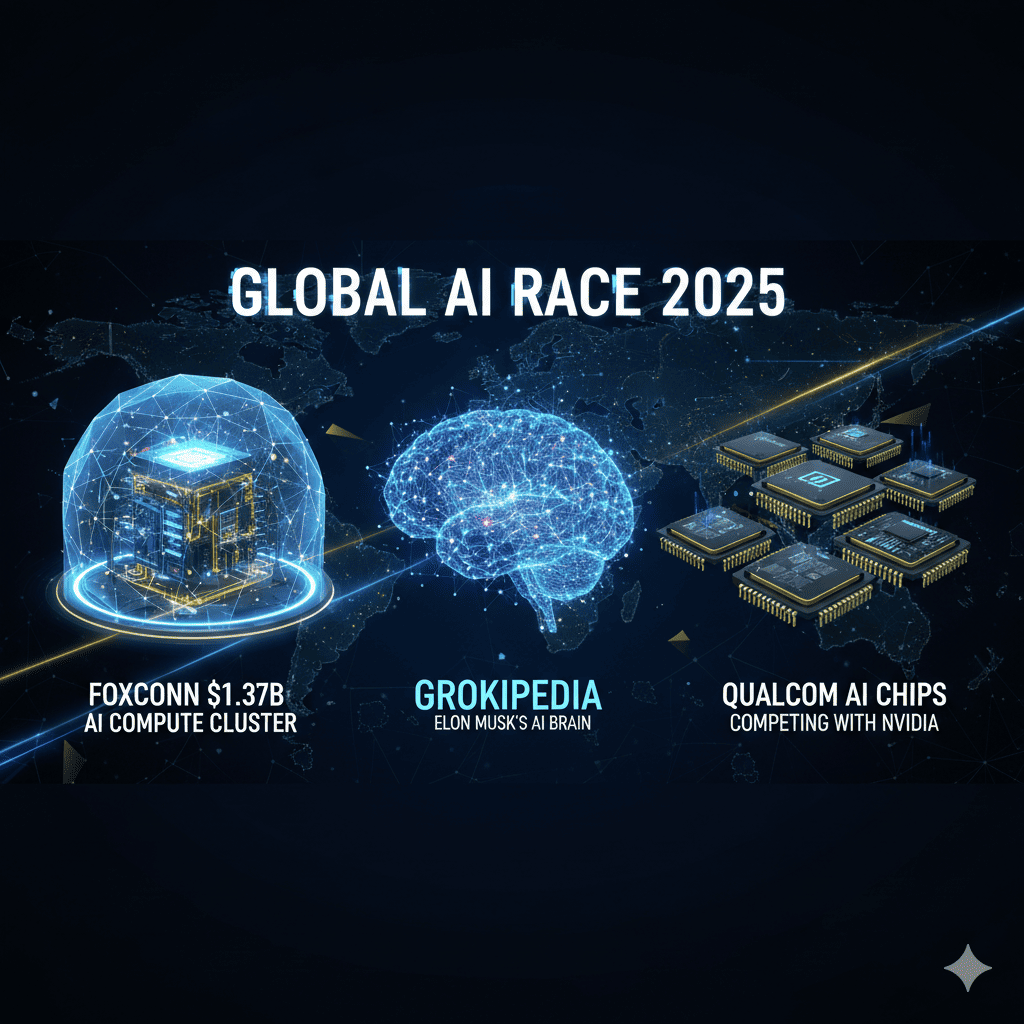
The global artificial intelligence (AI) landscape is witnessing an extraordinary wave of innovation and investment. From hardware giants to tech visionaries, companies across the globe are racing to dominate the next era of AI infrastructure and intelligence. This week, three major announcements underscored how rapidly this transformation is unfolding: Foxconn’s approval of a $1.37 billion AI compute cluster, Elon Musk’s launch of Grokipedia, and Qualcomm’s unveiling of new AI chips to challenge Nvidia.
Together, these moves signal a deepening global push to advance AI compute power, democratize data access, and reshape the semiconductor landscape.
Foxconn’s $1.37 Billion Investment: Building the Next AI Powerhouse
Taiwanese electronics giant Foxconn—best known for assembling iPhones and other consumer electronics—has now set its sights on becoming a leader in AI infrastructure. The company recently received government approval for a $1.37 billion investment to establish an AI compute cluster, a move that marks one of its largest technology investments in recent years.
The new AI cluster will be designed to power large-scale AI training and data analytics workloads, providing computing resources for global clients, startups, and enterprises focused on AI-driven applications. Analysts view this as a strategic pivot for Foxconn, aligning with the world’s growing demand for AI computing capacity—the backbone of technologies like generative AI, autonomous vehicles, and robotics.
The cluster will likely feature advanced GPU and CPU systems, similar to those used in leading data centers by companies like Google and Microsoft. Foxconn’s entry into this segment also supports Taiwan’s goal of strengthening its role in the global semiconductor and AI supply chain, diversifying beyond contract manufacturing into higher-value technology services.
As AI models grow more complex and data-intensive, such large-scale compute investments will become increasingly vital. Foxconn’s move positions it not just as a supplier to the world’s biggest tech brands but as a global enabler of AI innovation
Elon Musk’s Grokipedia: A New Approach to AI Knowledge
In a different corner of the AI world, Elon Musk is once again making waves. His AI startup xAI, known for developing the Grok chatbot, has launched a new platform called Grokipedia.
Grokipedia is envisioned as a community-driven knowledge hub that integrates verified, real-time, and user-contributed information to make Grok smarter and more reliable. Musk’s aim is to create an ecosystem where human knowledge and AI learning can evolve together—something akin to an open-source Wikipedia for AI.
The concept reflects Musk’s broader vision of truth-seeking AI—models that are transparent, connected to real-world data, and less prone to misinformation. Grokipedia will likely play a central role in feeding Grok with factual, dynamic data from across the internet, combining the reliability of human curation with the scale of machine learning.
The launch also highlights Musk’s ongoing rivalry with OpenAI, the maker of ChatGPT. While OpenAI focuses on developing general-purpose AI tools for productivity, Musk’s approach leans toward creating AI that thinks critically and questions mainstream narratives. Grokipedia could be the foundation for building that intelligence—an AI that learns not just from data but from the collective reasoning of people.
If successful, Grokipedia could reshape how AI models interact with information—transforming static datasets into living, evolving knowledge systems.
Qualcomm Takes on Nvidia: New AI Chips for the Next Generation
While Musk and Foxconn target the data and knowledge sides of AI, Qualcomm is making a bold move in the hardware race. The company has unveiled its next-generation AI chips, designed to challenge Nvidia’s dominance in AI processing.
Nvidia currently leads the global market for AI chips, with its GPUs powering most of the world’s AI data centers and model training environments. However, Qualcomm’s new chips—optimized for both on-device AI and data center performance—aim to provide a more efficient, cost-effective alternative.
These chips are built using cutting-edge 4nm technology and feature specialized neural processing units (NPUs) capable of handling complex AI workloads directly on devices such as smartphones, laptops, and autonomous systems. Qualcomm’s approach emphasizes AI at the edge, reducing dependency on cloud servers and lowering latency for real-time AI applications.
The company’s strategy could prove significant as AI continues to move beyond centralized data centers into everyday devices. Edge AI enables faster processing, improved privacy, and reduced bandwidth costs—making it ideal for next-generation applications like AI-powered assistants, real-time translation, and smart robotics.
According to reports from Reuters and Mint, Qualcomm’s goal is not necessarily to dethrone Nvidia outright but to broaden the AI chip ecosystem, giving developers more options for different scales and use cases. Still, the competition could push Nvidia to innovate even faster—potentially accelerating the overall pace of AI hardware advancement.
A Convergence of Forces: Infrastructure, Intelligence, and Hardware
When viewed together, these three developments represent the three pillars of the modern AI revolution:
Infrastructure (Foxconn) – building the computing foundations that power AI globally.
Intelligence (Musk’s Grokipedia) – redefining how AI systems learn, reason, and evolve.
Hardware (Qualcomm) – creating faster, smaller, and more efficient chips to make AI ubiquitous.
This convergence reflects how AI is no longer confined to research labs or big tech firms. It is rapidly expanding into every sector—from manufacturing and logistics to media, education, and healthcare.
Foxconn’s AI cluster could power thousands of startups. Grokipedia might reshape AI’s relationship with truth. Qualcomm’s chips could bring real-time intelligence to billions of connected devices. Together, they form a snapshot of an AI ecosystem that is becoming more interconnected, competitive, and democratized
The Road Ahead
As the AI race intensifies, collaboration and competition are fueling progress simultaneously. Governments, corporations, and innovators are all recognizing that AI is the new economic infrastructure—the foundation upon which future industries will be built.
Yet challenges remain. Power consumption, chip shortages, data privacy, and AI regulation will all play crucial roles in shaping how these technologies evolve. Companies like Foxconn, Musk’s xAI, and Qualcomm will need to navigate not only technical hurdles but also ethical and geopolitical ones.
Still, one thing is clear: the pace of AI advancement shows no sign of slowing down. Each new investment, platform, or chip release brings us closer to a world where AI becomes as essential as electricity—an invisible force powering every aspect of modern life.
Conclusion
From Foxconn’s billion-dollar data cluster to Musk’s vision of collective intelligence and Qualcomm’s hardware innovations, these announcements together mark a defining moment in the AI timeline. The industry is no longer driven by a few players but by a global network of innovators competing to build the future.
As AI continues to evolve, such developments remind us that the real race is not just about faster chips or smarter bots—but about creating intelligent systems that empower humanity, connect knowledge, and transform how the world thinks, builds, and communicates.