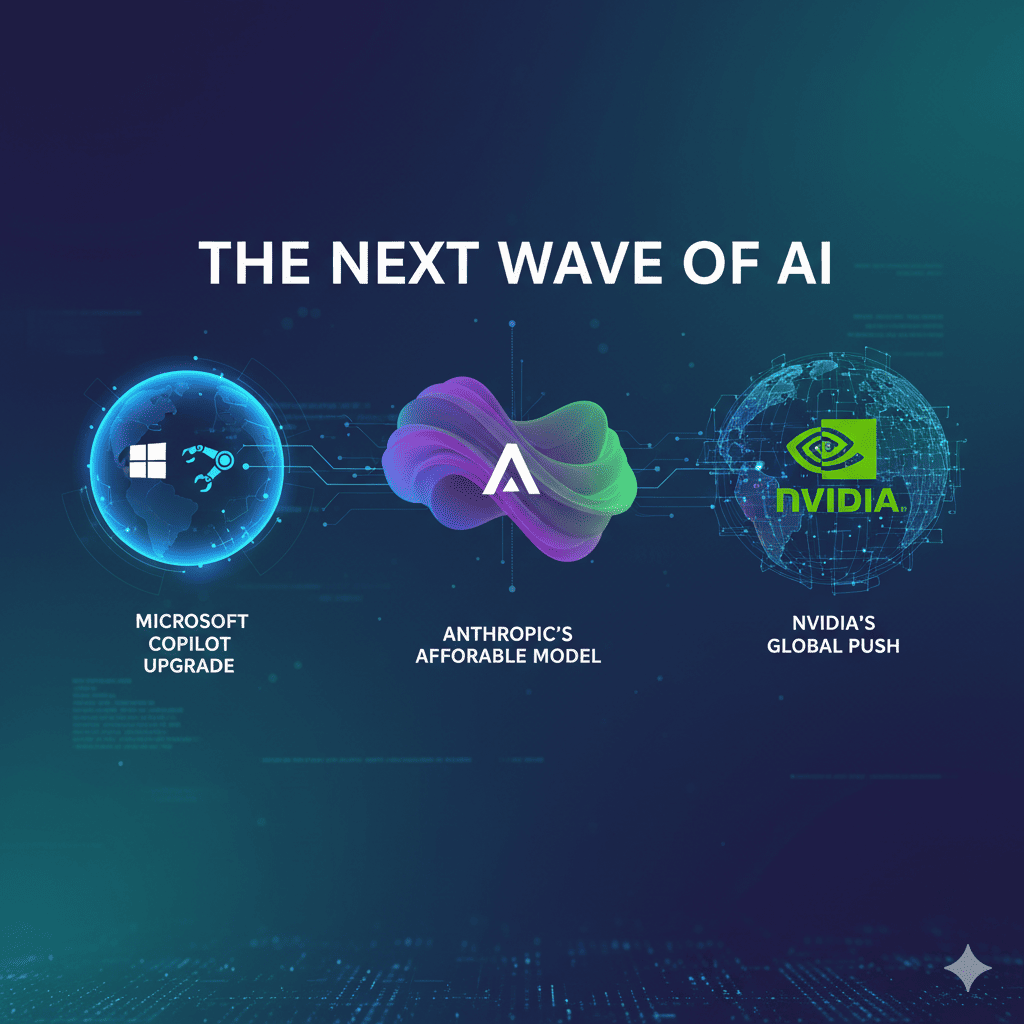
The AI revolution continues to accelerate, with major players like Microsoft, Anthropic, and Nvidia announcing key developments that could reshape the global tech landscape. Microsoft is doubling down on integrating its Copilot AI deeper into Windows 11, Anthropic has launched a cheaper and faster AI model, and Nvidia’s CEO Jensen Huang is taking the global AI conversation to the APEC CEO Summit in South Korea.
Together, these moves highlight a new phase of AI — one focused on accessibility, integration, and global influence
💻 Microsoft’s Copilot Becomes the Heart of Windows 11
Microsoft has announced a massive upgrade to Copilot in Windows 11, signaling its ambition to make every PC an AI-powered machine.
✨ Key New Features:
Voice Activation: Users can now say “Hey, Copilot” to instantly summon the AI assistant.
Copilot Vision: A new feature that allows the assistant to see what’s on your screen and help with tasks or information based on that context.
Copilot Actions: Enables users to perform real-world tasks — like booking reservations or ordering food — directly from their desktop.
Integrated Search Bar: The Windows 11 taskbar now includes a dedicated “Ask Copilot” chat interface, blending AI chat with local search.
Enterprise Enhancements: Optimized for commercial devices and new Copilot+ PCs with built-in NPUs (neural processing units) for faster performance
🔍 Why It Matters:
Microsoft is transforming Windows from a static OS into an AI-first ecosystem. With AI now woven into the desktop, the company is positioning itself ahead of Google and Apple in making AI a natural part of daily computing.
However, as Copilot becomes more powerful and integrated, concerns about privacy, data access, and user control will remain in focus.
🤖 Anthropic’s Claude Haiku 4.5: Affordable AI for Everyone
AI startup Anthropic has unveiled its latest model — Claude Haiku 4.5 — a lightweight yet powerful alternative to its premium Opus and Sonnet models.
💡 Highlights:
Cost-Effective: Around one-third the price of Anthropic’s mid-tier Sonnet 4 model and fifteen times cheaper than the flagship Opus.
Speed & Efficiency: Haiku 4.5 runs faster while matching (and in some cases surpassing) the accuracy of larger models in code generation and workflow automation.
Availability: The model is live on Anthropic’s API and ready for developers and startups to integrate into their products.
🧠 Why It Matters:
Haiku 4.5 represents a shift in how AI companies are thinking — it’s not just about bigger models, but smarter, faster, and more affordable ones.
This move could democratize AI adoption for small businesses, startups, and independent developers who can now access high-quality AI capabilities without massive budgets.
In markets like India, where cost efficiency is crucial, this could greatly expand the adoption of AI tools across industries like education, finance, and logistics.
🌏 Nvidia’s Jensen Huang at the APEC CEO Summit
Nvidia CEO Jensen Huang is set to attend the 2025 APEC CEO Summit in Gyeongju, South Korea — one of the most influential gatherings of global business leaders.
🔔 Key Focus Areas:
Strengthening partnerships with Samsung Electronics and SK Hynix, two major memory suppliers for Nvidia’s AI chips.
Discussing the future of AI infrastructure, robotics, and data centers in the Asia-Pacific region.
Exploring opportunities for collaboration amid U.S.–China tech tensions and global supply chain shifts.
🌍 Why It Matters:
Nvidia’s participation underscores how AI is not just a software trend — it’s a geopolitical and industrial powerhouse. The company’s dominance in GPUs makes it central to every AI data center project across the world.
By strengthening ties in Korea, Nvidia is helping turn Asia into a critical hub for AI hardware and data infrastructure — a move that will likely impact pricing, availability, and innovation globally.
🔗 Connecting the Dots: What These Moves Mean
These three stories — Microsoft’s AI integration, Anthropic’s affordable model, and Nvidia’s global expansion — together paint a clear picture of where AI is headed:
| Trend | Example | Impact |
|---|---|---|
| AI Integration | Microsoft Copilot in Windows 11 | Makes AI a native part of every PC |
| AI Accessibility | Anthropic Claude Haiku 4.5 | Lowers costs, increases adoption |
| AI Infrastructure | Nvidia’s APEC Participation | Strengthens global chip and compute ecosystem |
The result? A future where AI is everywhere — in your operating system, your apps, and even the supply chains that build your devices.
📊 Implications for Businesses and Users
🏢 For Businesses: AI will no longer be optional — it will be embedded in the tools you already use. From smarter desktops to affordable models, there’s a huge opportunity for automation and efficiency.
💻 For Developers: With Haiku 4.5 and Copilot integration, building AI-powered applications is becoming faster and cheaper.
🌐 For Asia & India: Expect to see increased investment in AI infrastructure, data centers, and local partnerships as Nvidia and Microsoft expand across the region.
🧭 Final Thoughts
The AI landscape is evolving from a phase of innovation to implementation.
Microsoft is bringing AI to billions of users through Windows.
Anthropic is making AI tools affordable for smaller players.
Nvidia is ensuring the global hardware backbone keeps up with demand.
This powerful trifecta represents the next step toward an AI-driven world — where software, hardware, and intelligence merge seamlessly.