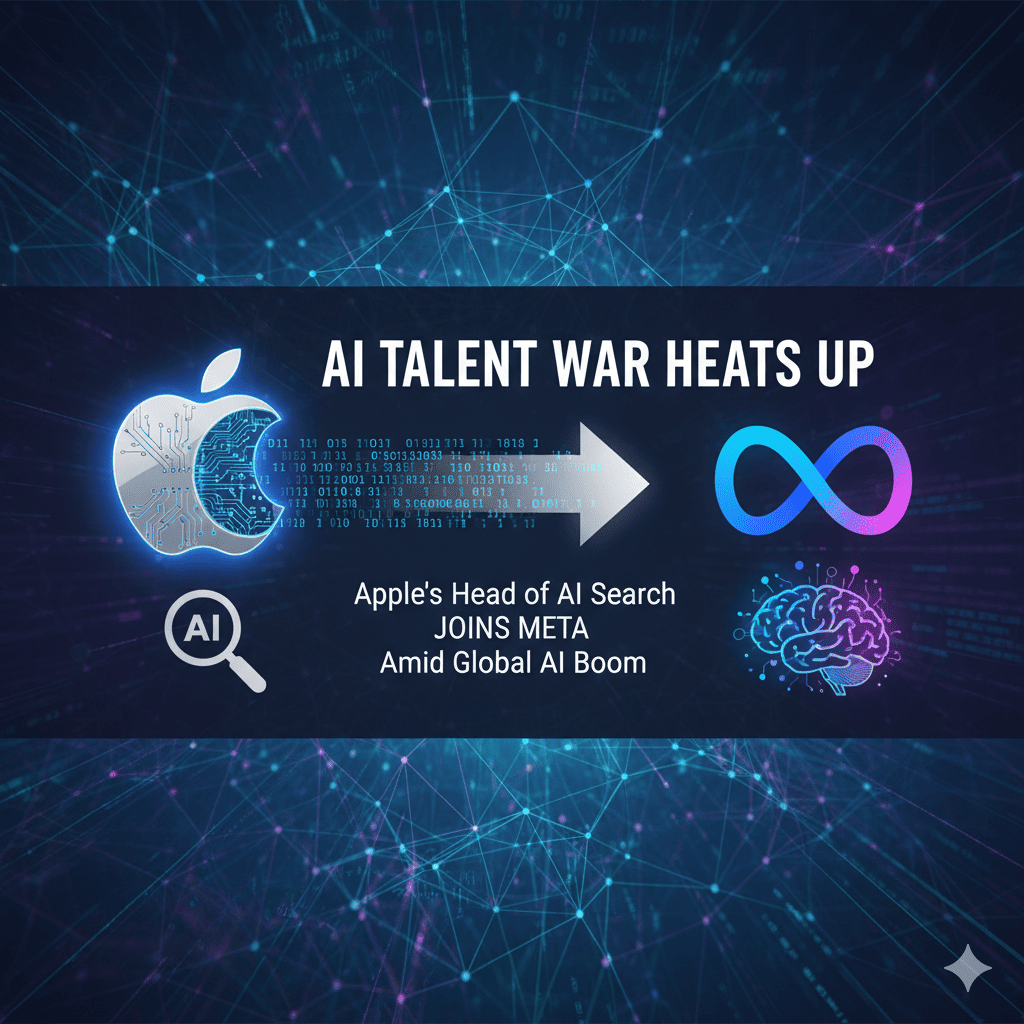
The world of artificial intelligence is moving faster than ever — and the latest shakeup proves it. In a major talent acquisition, Apple’s head of AI search has reportedly left to join Meta, signaling a new phase in the tech industry’s ongoing AI talent war. At the same time, AI is transforming critical sectors like healthcare and finance, while tech giants continue pouring billions into AI infrastructure to power the next generation of intelligent systems.
Let’s dive into what’s happening across the AI landscape.
Meta’s Big Win: Apple’s AI Chief Moves to Zuckerberg’s Camp
In a move making headlines worldwide, Ke Yang, Apple’s newly appointed head of its ChatGPT-like AI search project, has reportedly departed to join Meta. She was leading Apple’s “Answers, Knowledge, and Information” (AKI) team — responsible for modernizing Siri and developing Apple’s generative search systems.
This isn’t an isolated incident. Earlier this year, Ruoming Pang, who led Apple’s foundation models group, and Frank Chu, an AI infrastructure leader, also switched to Meta. These high-profile moves highlight Meta’s aggressive hiring spree as it builds out its “Superintelligence Labs” — a new division focused on achieving cutting-edge AI capabilities.
What this means:
Meta is investing heavily in both human talent and hardware, aiming to rival OpenAI, Google, and Anthropic in general-purpose AI.
Apple, traditionally cautious in AI disclosure, now faces growing pressure to accelerate its own AI ecosystem — especially with Siri and iPhone AI features lagging behind competitors.
The broader message? AI expertise has become the most valuable currency in the global tech market.
AI in Healthcare: From Stroke Detection to Virtual Doctors
AI’s potential in healthcare is moving from theory to practice.
In Punjab, India, a new AI-based public health initiative has screened over 700 suspected stroke patients using Qure.ai tools. Scans are automatically analyzed and sent to neurologists at a central hub — enabling faster diagnosis and life-saving interventions.
In the U.S., Counsel Health recently raised $25 million to expand its AI-augmented healthcare model. Their system pairs human doctors with AI assistants that handle triage, patient follow-ups, and data analysis — reducing doctor workload and improving care quality.
Google Cloud and Adtalem have also launched a global AI credential program for healthcare professionals, ensuring safe, ethical use of AI in clinical workflows.
Why it matters:
AI is addressing some of healthcare’s biggest challenges — from limited specialist access to diagnostic delays. The result is a future where AI doesn’t replace doctors but empowers them with speed, accuracy, and insight.
AI in Finance: Fighting Fraud and Redefining Money Management
The financial world is also witnessing a quiet revolution.
In Kerala, fintech startup Ignosi Enterprises unveiled an AI-powered fraud detection system to spot fake gold loan pledges. Using facial recognition and behavioral analytics, it helps banks flag suspicious activities before losses occur.
UBS, the global banking giant, recently appointed a Chief AI Officer, focusing on integrating generative AI into trading, compliance, and customer experience.
Plaid’s CEO predicts that soon, AI agents could manage personal finances — automating savings, transfers, and investments — while still requiring strong regulation and user trust.
Bottom line: AI is becoming the invisible brain of global finance — detecting fraud, predicting risks, and even advising customers in real-time.
The Infrastructure Boom: Billions Flow into AI Data Centers
Behind every AI breakthrough lies a massive computing engine — and investments in AI infrastructure are skyrocketing worldwide.
Meta is finalizing a $30 billion financing deal for its upcoming Louisiana Hyperion Data Center, a state-of-the-art facility expected by 2029.
Oracle forecasts that its cloud infrastructure business will hit $166 billion by 2030, with major expansions linked to AI partnerships, including OpenAI.
Google, AdaniConneX, and Airtel announced a $15 billion AI data hub in Visakhapatnam, India — one of Google’s largest global infrastructure investments.
Meanwhile, a $40 billion acquisition by BlackRock, Nvidia, and Microsoft of Aligned Data Centers will add 5+ gigawatts of AI-ready capacity worldwide.
OpenAI and Broadcom are collaborating to build custom AI chips, reducing reliance on third-party suppliers and boosting energy efficiency.
The takeaway:
The world’s biggest companies are racing to secure the compute power that fuels generative AI. Those who control infrastructure will control innovation.
What It All Means
These three fronts — talent, application, and infrastructure — define the next stage of the AI era.
Talent migration shows where the intellectual gravity is shifting: from closed research to open-scale deployment.
Sector applications in healthcare and finance prove AI’s real-world value beyond chatbots and content generation.
Infrastructure expansion demonstrates that AI is now a capital-intensive industry, not just a research experiment.
For countries like India, this is both an opportunity and a challenge. The rise of AI hubs like Visakhapatnam and startups in health and finance AI could put India on the global AI map — if the momentum continues.
Final Thoughts
The global AI ecosystem is evolving rapidly — powered by talent moves, technological breakthroughs, and trillion-dollar infrastructure bets.
As Apple and Meta battle for top minds, and as healthcare and finance get smarter with AI, one thing is clear: we’re witnessing the industrialization of intelligence itself.
The companies investing today — in people, power, and purpose — are shaping how humanity will think, heal, and trade tomorrow.