Introduction: The European game has begun.
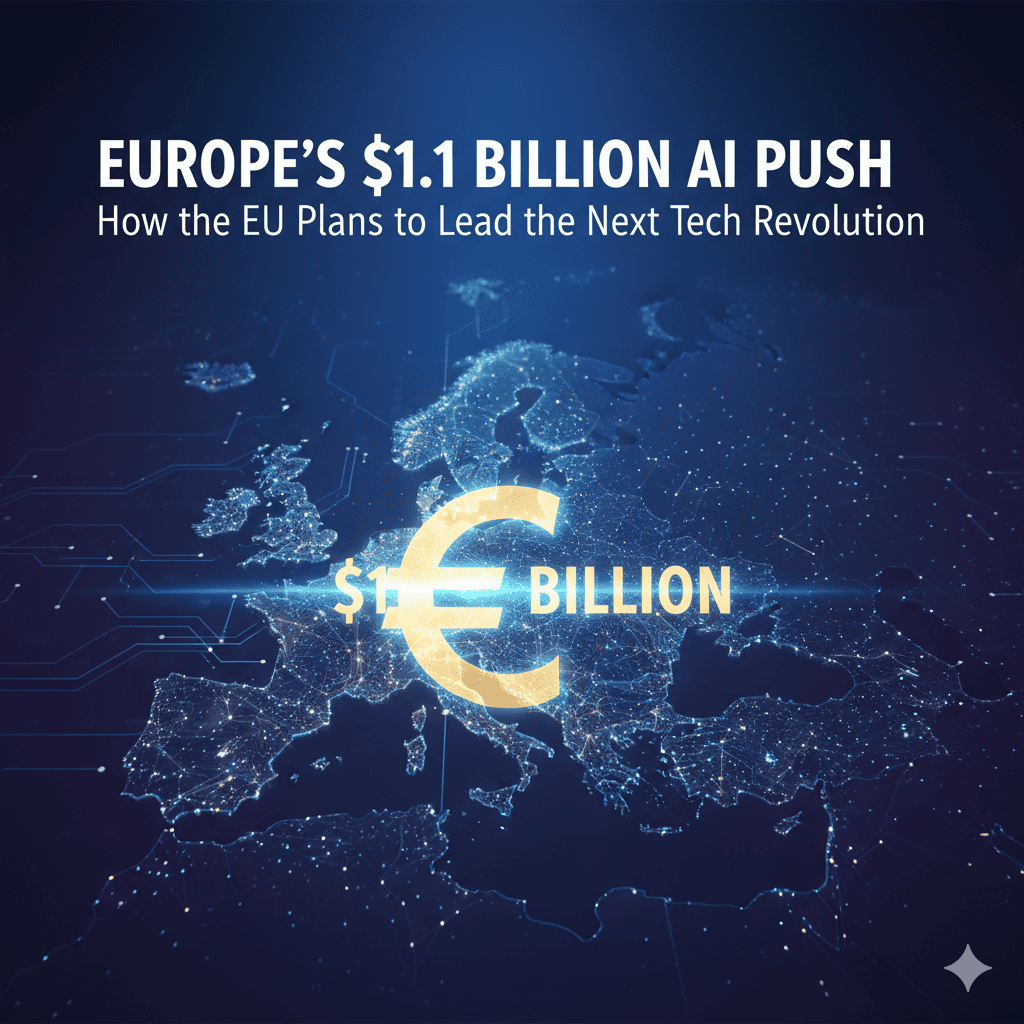
Artificial Intelligence (AI) is no longer just a game of Silicon Valley or China. The European Union (EU) has officially launched its AI Power Plan – a massive $1.1 billion (approx. ₹9,000 crore) initiative aimed at deeply integrating AI into key European industries.
The main purpose of this move is AI sovereignty – that is, Europe should have control over its own AI technology and data, without depending on tech giants from the U.S. and China.
This step is a clear signal that Europe is now making a serious entry into the AI battlefield.
Why EU Took This Step: The Need for Tech Independence
For the past few years, global leadership in AI innovation has been held by the U.S. (OpenAI, Google, Anthropic) and China (Baidu, Alibaba, Tencent). Europe has powerful research institutions, but there was a gap in large-scale AI infrastructure and commercial models.
The EU realized that if it lags behind the AI wave, then:
Its industries (automotive, manufacturing, healthcare) could become outdated
Data sovereignty could be at risk (because of the dependence on U.S. cloud and model providers)
Employment and innovation would suffer.
Therefore, this $1.1B plan is both a strategic self-defense and an economic opportunity.
What the Plan Includes: Key Highlights
1- Funding for AI Startups & Research Labs
The EU will fund AI research centers and startups through direct grants and public-private partnerships.
Focus areas: robotics, energy efficiency, health diagnostics, semiconductors
Goal: Support 1,000+ European AI startups by 2026
2- Supercomputing Infrastructure Expansion
Europe is already operating the “EuroHPC” supercomputing network. This plan places a major focus on building AI-ready supercomputers, so that models can be trained within Europe.
3 – AI Regulation & Ethical Framework
The EU has already passed the AI Act—which defines ethical and safety standards for AI.
Now, this plan will ensure that AI growth and governance remain balanced.
4 – Industry Integration
AI adoption projects will be started in sectors like automotive, manufacturing, energy, agriculture.
Example: Smart factories, predictive maintenance, clean-energy optimization etc.
5- Talent & Education Initiatives
AI-specific curriculum will be launched in universities and vocational programs.
Target: To create 1 million skilled AI professionals in the next 5 years.
Impact on Global AI Landscape
This move by Europe could lead to a global tech rebalancing.
Challenge for U.S. companies: Firms like Microsoft and Google will face direct competition in European tenders.
Barrier for China: As Europe builds its own AI ecosystem, restrictions on Chinese AI imports could increase.
Opportunity for India: India-EU collaborations in AI training, cloud computing, and ethical AI research could grow.
This plan will indirectly create a “third pole”—Europe wants to show its own independent AI route—amidst the US-China rivalry.
The Sovereignty Angle: Data is the New Oil
The EU’s biggest motivation is data sovereignty.
The success of AI depends on data, and until now, European data has been processed mostly on U.S. tech clouds.
Through this plan, the EU will ensure:
Data localization — European data is stored and processed within Europe.
Open-source and transparent AI — Transparent AI frameworks should be created instead of proprietary closed models.
Digital sovereignty — Europe can make its own digital decisions, without any external dependency.
All of this is part of the EU’s long-term geopolitical vision — where it wants to achieve tech autonomy.
Challenges Europe Might Face
Every big project comes with its own challenges, and here are some key hurdles for the EU’s AI plan:
1-Slow Bureaucracy
The EU’s decision-making processes are slow. Rapidly scaling innovation could be difficult.
2 -Talent Shortage
Europe has fewer AI researchers and data scientists than the U.S. and Asia.
3- Private Investment Gap
AI startups need private capital for long-term funding—which is currently low in Europe.
4- Regulatory Overload
The EU’s AI Act is ethical, but overly strict rules could slow innovation.
5- Global Competition
Taking a stand against the U.S.’s OpenAI-Nvidia ecosystem and China’s government-backed AI programs is not easy.
Long-Term Benefits for Europe
If this plan is implemented correctly, Europe will have multiple benefits:
High-tech job creation (AI engineers, data analysts, cloud experts)
Sustainable and efficient industries (less waste, more automation)
Enhanced competitiveness (European firms will be able to compete globally)
Secure data ecosystems (privacy and progress with ethical AI)
Academic excellence (European universities could become top AI research hubs)
Global Reactions & Market Sentiment
Global markets have reacted mixedly to this announcement:
AI-related European ETFs showed a slight uptick, especially in stocks of tech manufacturing and cloud firms.
U.S. investors are cautious, as European regulations could limit the pace of innovation.
Indian tech companies (like Infosys, TCS) have expressed interest in EU collaborations.
According to experts, this plan is a long-term play, the impact of which will be clearly visible after 3-5 years.
Conclusion: A Bold Step for Europe’s AI Future
Europe’s $1.1 billion AI plan is a turning point—not just for technology, but also for geopolitical and economic balance.
While the U.S. and China race for AI dominance, the EU’s focus is on ethical, sustainable, and human-centered AI.
If this vision is executed in the right direction, Europe could become the silent leader of AI in the next decade.
And most importantly—this initiative is a reminder that the AI revolution has now truly gone global.